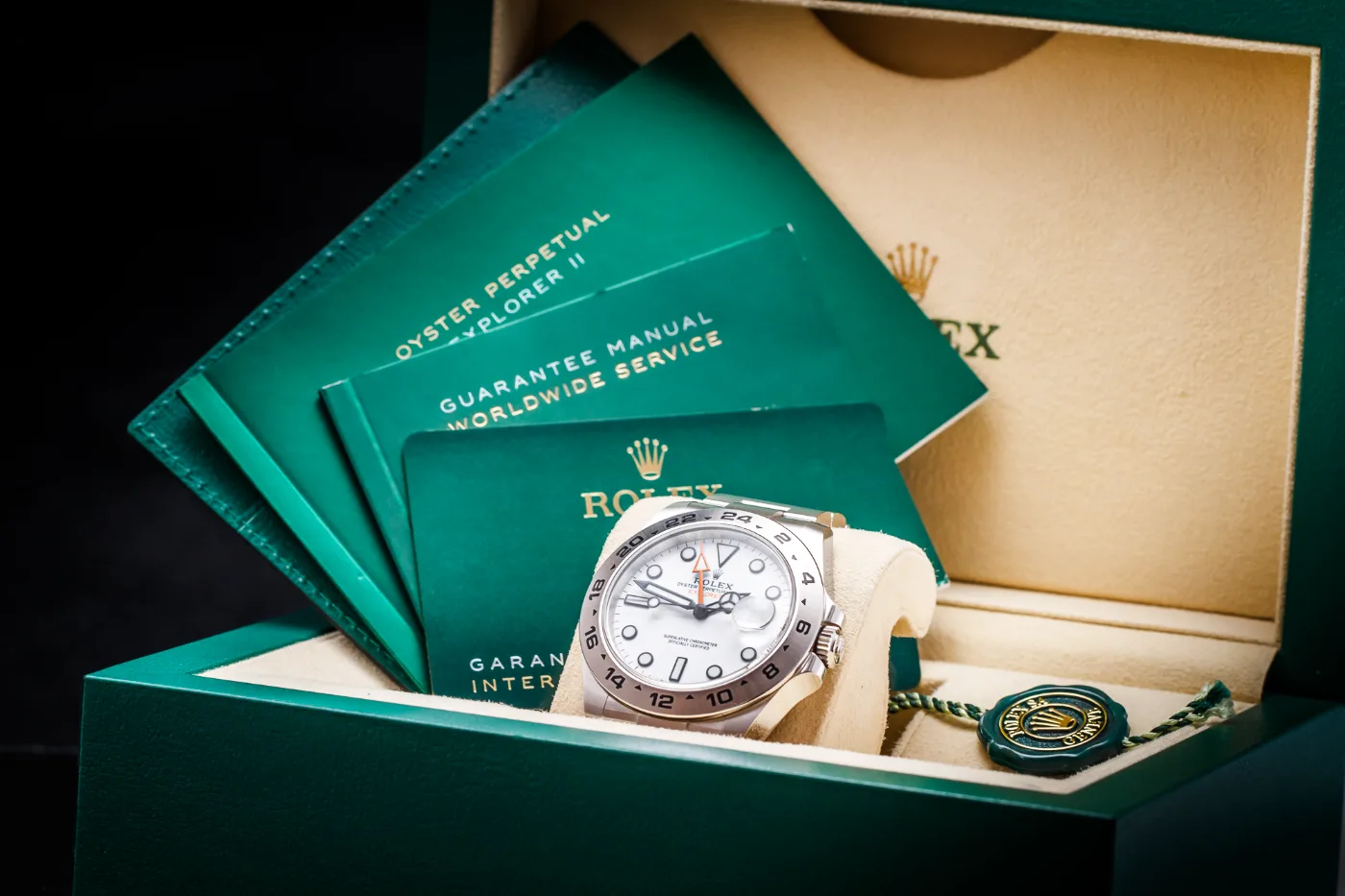
Rolex Explorer II "Polar Dial" 216570

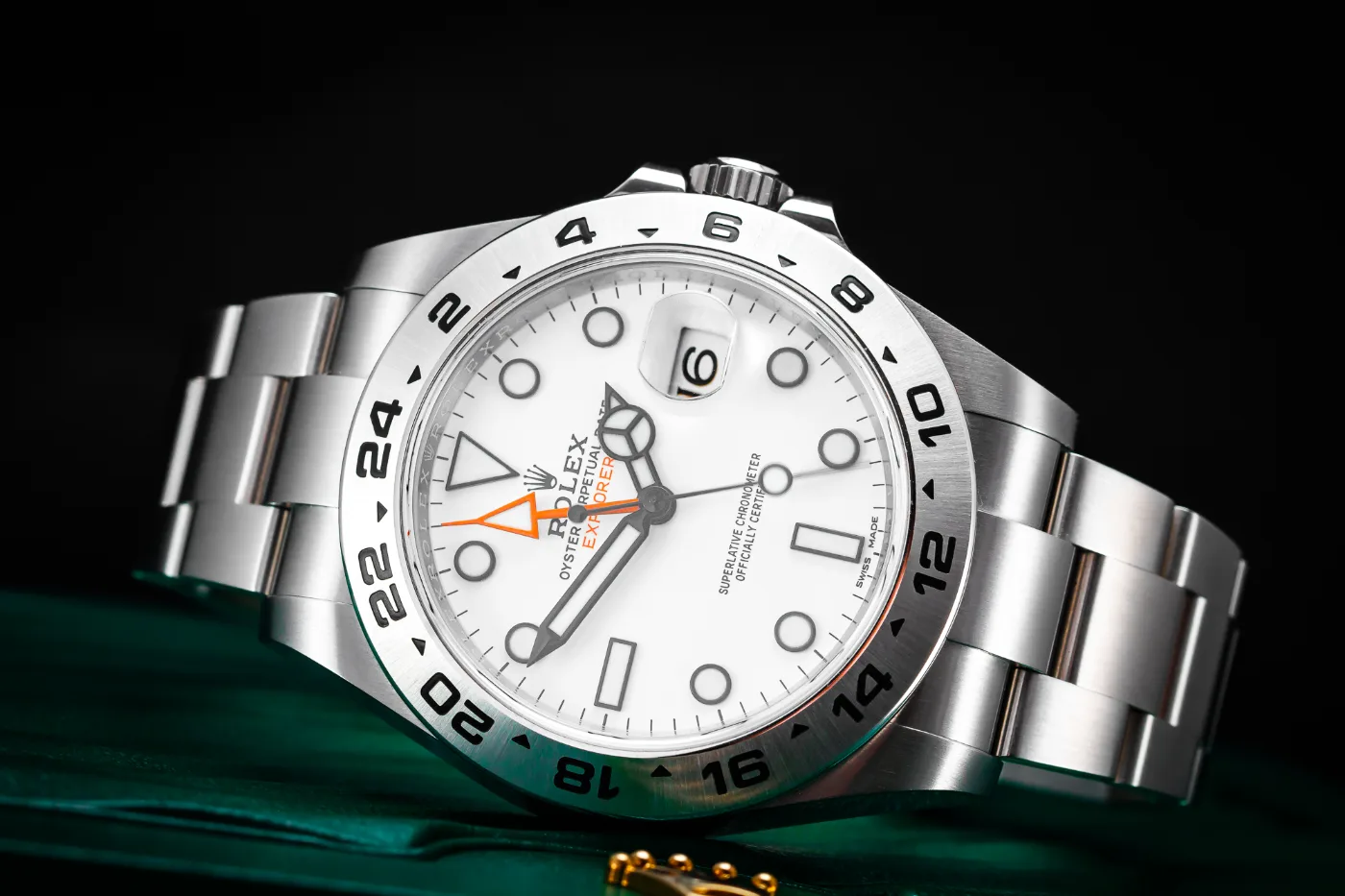
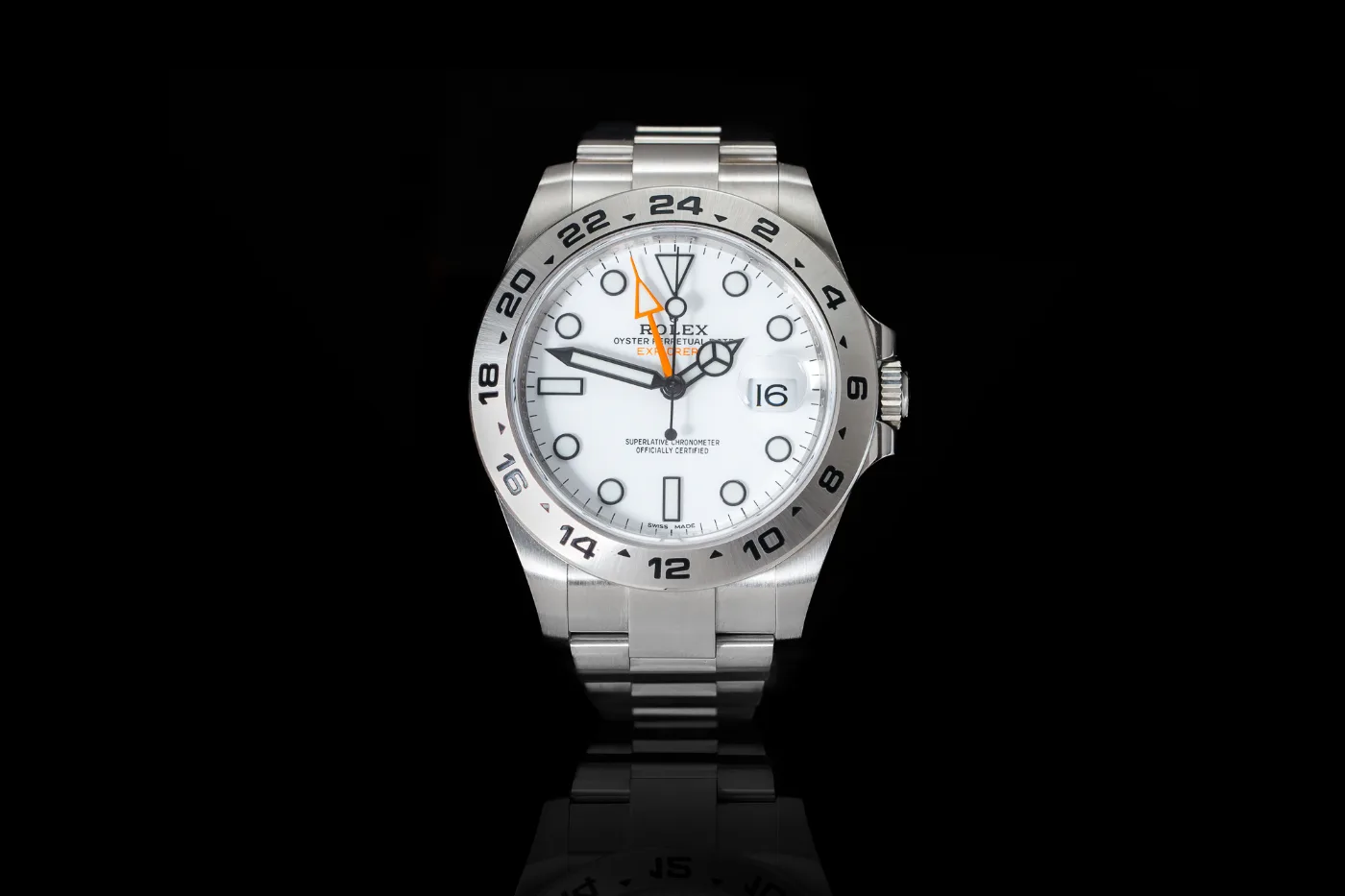
Elegant Rolex Explorer watch made of steel. Features a white dial, automatic movement, and 42mm case.

Brand
Rolex
Model
Explorer II
REFERENCE
216570
CASE MATERIAL
Steel
CASE DIAMETER
42 mm
MOVEMENT
Automatic
BRACELET
Oyster
DIAL COLOR
White
CONDITION
Very Good
YEAR OF PRODUCTION
2020
VALUE
41,900 PLN
WARRANTY
Lifetime Warranty
Case Size
42
Reference Number
216570

Rolex Explorer II „Polar Dial” 216570, white dial, Oystersteel 42 mm

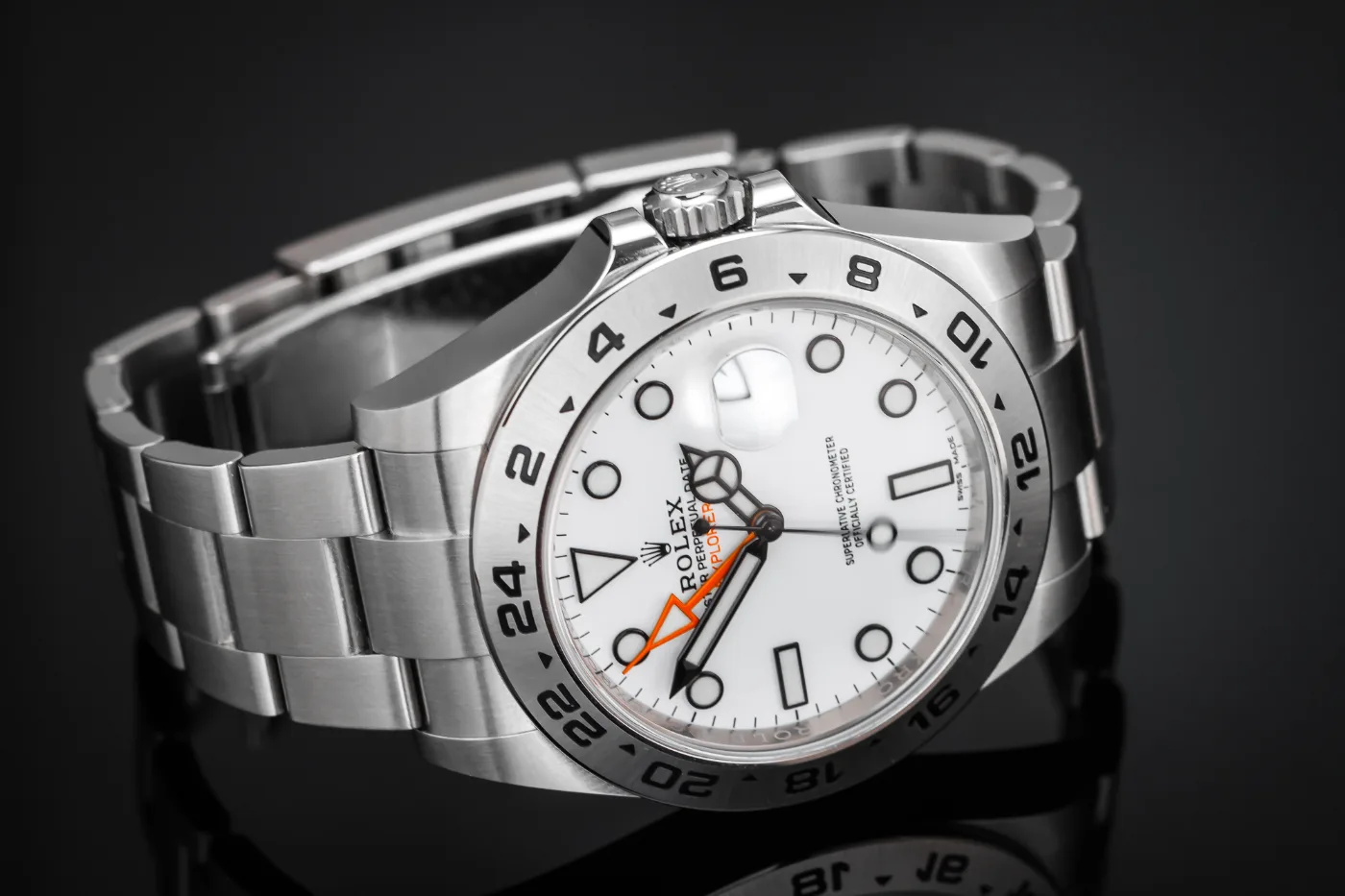
The Rolex Explorer II „Polar Dial” with reference 216570 is one of the most distinctive professional Rolex watches from the previous generation. This model combines a large Oyster case for a classic brand watch with a diameter of 42 mm, a white dial with exceptionally high contrast, an orange 24-hour hand, a fixed steel bezel engraved with a 24-hour scale, and an Oyster three-link bracelet.

The white configuration is identified as Rolex Oyster Perpetual Explorer II 216570-0001. Official Rolex documentation for this reference specifies a white dial, a 42 mm case made of Oystersteel, a fixed 24-hour bezel, the automatic caliber 3187, approximately 48 hours of power reserve, a sapphire crystal with a Cyclops lens, water resistance to 100 meters, and an Oyster bracelet with Oysterlock and Easylink.

The term „Polar” or „Polar Dial” is not an official Rolex name. It is a widely used collector's nickname referring to the white dial of the Explorer II. The name fits the collection's history perfectly, as the Explorer II was designed, among other things, for environments where natural distinction between day and night becomes difficult, such as caves or polar regions, where the sun may not set for a long time during summer. Rolex itself cites caves and polar regions as examples of where the 24-hour indication of the Explorer II is applied.

The full identification of the watch described is:

Rolex Oyster Perpetual Explorer II 216570-0001 „Polar Dial”, 42 mm, white dial, Oystersteel, Oyster bracelet.

Reference 216570 appeared in 2011, exactly on the 40th anniversary of the Explorer II. Rolex significantly modernized the model at that time, increasing the case diameter to 42 mm and restoring the large orange 24-hour hand, characteristic of the original Explorer II from 1971. Inside, it featured the caliber 3187, specially prepared for this model, with a Parachrom hairspring and Paraflex shock absorbers.

In 2021, reference 216570 was replaced by a new generation, 226570. The 42 mm diameter, characteristic white dial, and orange 24-hour hand were retained, but the new Rolex caliber 3285 was used, providing approximately 70 hours of power reserve. Thus, 216570 remains a closed generation of the Explorer II, whose character is defined by the 3187 caliber, approximately 48 hours of power reserve, and the design introduced for the collection's 40th anniversary.

M&M GOLD's tradition in the luxury goods industry dates back to 1985. M&M GOLD experts help find the precisely specified Rolex Explorer II 216570 Polar, verify the correct dial variant, watch authenticity, caliber 3187, second time zone function, and the technical condition of a specific example.

Rolex Explorer II „Polar Dial” 216570, key parameters

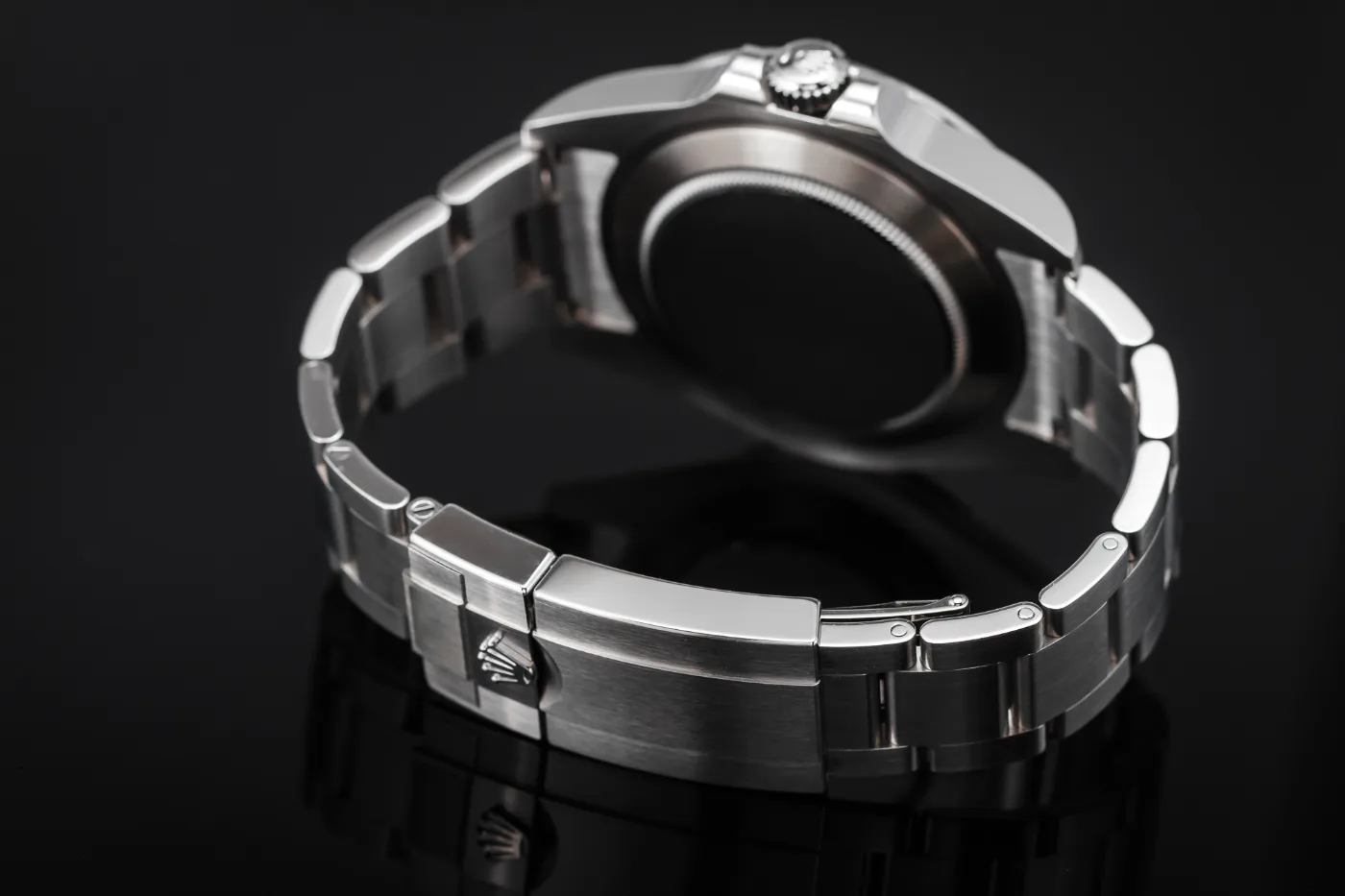
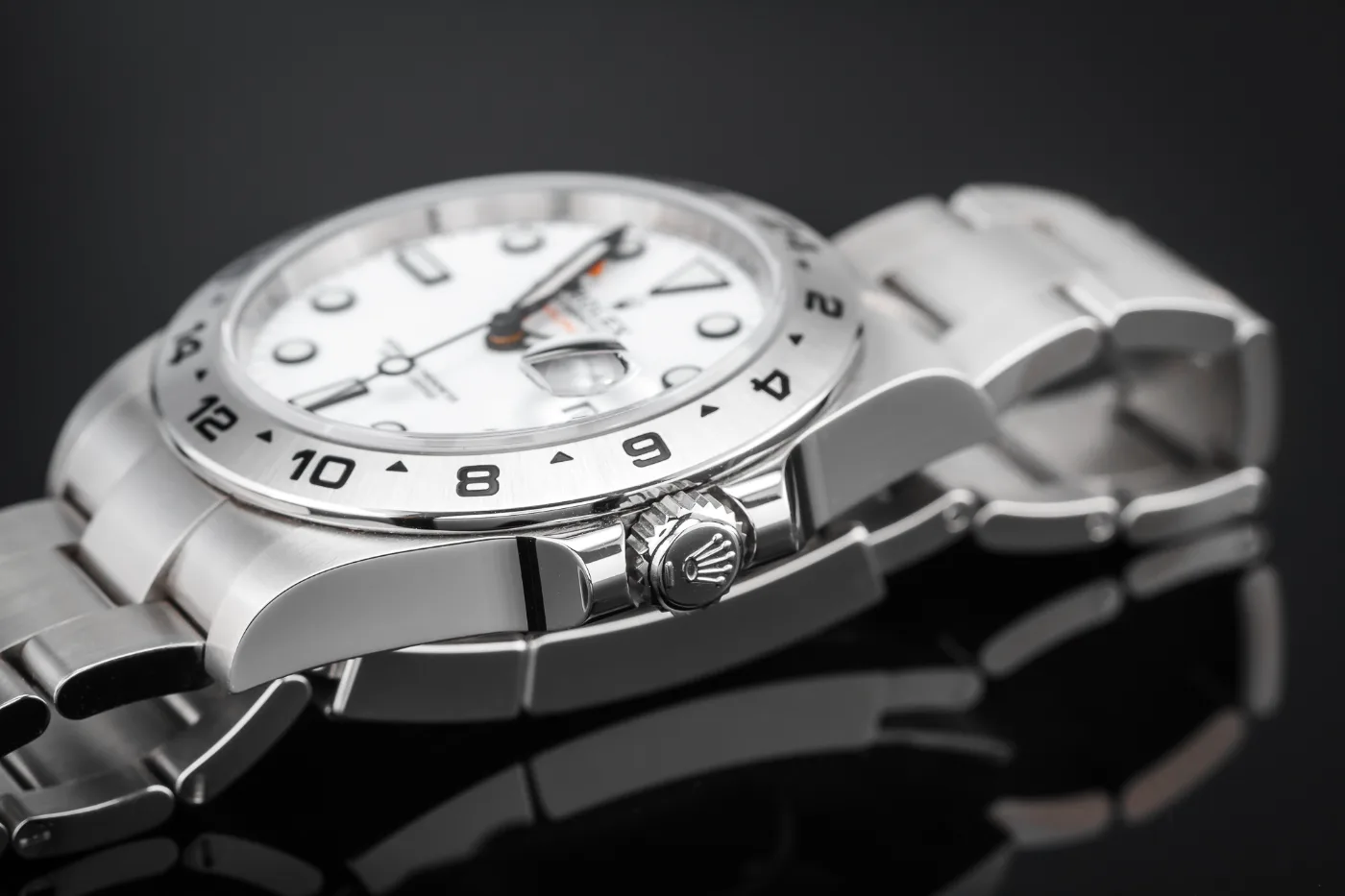
The Rolex Explorer II 216570-0001 features an Oyster case with a diameter of 42 mm made of Oystersteel from the 904L steel family, a white dial, a fixed steel bezel with a 24-hour scale, the characteristic orange 24-hour hand ending in a large arrowhead, central hour, minute, and second hands, a date window at 3 o'clock, a Cyclops lens, the automatic in-house Rolex caliber 3187, independent quick setting of the local hour hand, hacking seconds, approximately 48 hours of power reserve, a paramagnetic blue Parachrom hairspring, Paraflex shock absorbers, a screw-down Twinlock crown, sapphire crystal, water resistance to 100 meters, Chromalight display with long-lasting blue luminescence, and a three-link Oyster bracelet with an Oysterlock safety folding clasp and Easylink system allowing the bracelet length to be increased by approximately 5 mm.

Frequently Asked Questions about Rolex Explorer II „Polar Dial” 216570

What is the reference number of the Rolex Explorer II Polar Dial?

The white Explorer II of the previous generation has the base reference 216570, while the official configuration with a white dial is designated as 216570-0001.

Is „Polar Dial” an official Rolex name?

No. Officially, Rolex simply refers to the dial as white. „Polar” or „Polar Dial” is a very common nickname used by collectors and professional dealers.

Why is the white Explorer II called Polar?

The nickname primarily refers to the snow-white dial and the adventurous character of the model. An additional justification is the history of the Explorer II, which was designed with people operating in environments such as caves and polar areas in mind, where natural recognition of day and night can be difficult.

Is every Rolex Explorer II 216570 a Polar?

No. Reference 216570 was available with both white and black dials. The term Polar primarily refers to the white version.

What is the exact variant of the white dial?

Rolex Explorer II 216570-0001. The official Rolex brochure for this variant indicates a white dial.

When did Rolex introduce the Explorer II 216570?

In 2011. The model was presented on the occasion of the 40th anniversary of the Explorer II.

Why was the year 2011 important for the Explorer II?

Rolex then undertook a major modernization of the model. The case was increased to 42 mm, the characteristic orange 24-hour hand known from the original Explorer II from 1971 was restored, and the watch received the 3187 caliber.

Until when was the 216570 produced?

The 216570 generation remained the representative of the Explorer II until 2021, when Rolex presented the new 226570 generation powered by the 3285 caliber.

Is the Rolex Explorer II 216570 still in production?

No. This is a discontinued generation. The current successor is the Explorer II 226570.

Does Rolex still produce the white Explorer II?

Yes. The white dial remains part of the collection even after the generation change, but the contemporary model has reference 226570 and the 3285 caliber.

Is the new 226570 also called Polar?

Yes, the term Polar is used by the market for the white 226570 as well. Therefore, when purchasing, it is best to always use the exact reference number to distinguish between generations.

What is the diameter of the Rolex Explorer II 216570?

42 mm. This was one of the most important changes introduced in 2011.

Was the 216570 the first 42 mm Explorer II?

Yes. Rolex states that during the modernization for the 40th anniversary in 2011, the Explorer II diameter was increased to 42 mm.

Does 42 mm mean that the Explorer II is a large Rolex?

Yes. Compared to many classic Rolex models, 42 mm gives it a distinct presence on the wrist. However, one must also take into account the case shape, bracelet width, and individual wrist structure.

Is the 216570 larger than the Rolex GMT-Master II?

Yes, in terms of nominal case diameter. The Explorer II 216570 has 42 mm, while the contemporary GMT-Master II uses a 40 mm case.

What is the 216570 made of?

Oystersteel. Rolex classifies Oystersteel as steel belonging to the 904L alloy family, prized for its high corrosion resistance.

Does Rolex use 904L steel in the 216570?

The official Rolex brochure describes Oystersteel as steel belonging to the 904L family.

What color is the Polar dial?

White.

Why is the white dial of the Explorer II so distinctive?

The white background was paired with strongly emphasized dark outlines of hands and indices, and an intensely orange 24-hour hand. This ensures that the individual indications are clearly separated from each other.

Does the white dial have good functional properties?

Yes. The design of the Explorer II has always been subordinated to high legibility. Rolex cites legibility, resistance, and reliability as the fundamental characteristics of the Explorer collection.

What color is the 24-hour hand?

Orange. The hand is one of the most characteristic elements of the Explorer II.

Why is the GMT hand orange?

The orange hand directly references the first Explorer II from 1971. Rolex restored this characteristic element in 2011 on the occasion of the collection's 40th anniversary.

Is the 24-hour hand a GMT hand?

Functionally, it can be used to indicate a second time zone. Rolex describes the 24-hour function in the 216570 specification and the ability to display a second time zone thanks to the independent regulation of the local hour hand.

Does the Explorer II show two time zones?

Yes. The local hour hand can be set independently, while the orange 24-hour hand remains set to the reference time.

Does the Explorer II 216570 show three time zones?

No, not in the same way as the GMT-Master II with a rotating bezel. The Explorer II has a fixed 24-hour bezel, so its primary function is to simultaneously indicate local time and one reference time.

Does the Explorer II bezel rotate?

No. It is fixed. This is one of the fundamental differences between the Explorer II and the GMT-Master II.

Why is the bezel fixed?

The original function of the Explorer II was the reliable distinction between day and night using a hand making one rotation in 24 hours and a fixed scale. The construction was particularly useful in caves or polar regions where natural light may not clearly indicate the time of day.

Is the bezel ceramic?

No. In the 216570, this is a fixed metal bezel made of steel, with a clear 24-hour division.

Does the Explorer II have Cerachrom?

No. Reference 216570 does not use a ceramic Cerachrom bezel.

What does the number 24 on the bezel show?

It is part of the full 24-hour scale working in conjunction with the orange hand. One rotation of this hand corresponds to a full day.

How to distinguish day and night using the Explorer II?

If the 24-hour hand shows a value corresponding to hours 0 to 12, the user can determine the first half of the day, while values 12 to 24 allow unambiguous identification of the second half. This avoids the problem typical of a standard 12-hour indication.

Does the day/night distinction function have practical application today?

Yes, although most users primarily use the orange hand to observe a second time zone. The original function can still be useful in environments without a natural light cycle.

Can the local hour hand be adjusted independently?

Yes. The Rolex 216570 allows quick advancement of the local hour hand independently of the minute and 24-hour hands.

Why is the independent hour hand important during travel?

After changing time zones, the local hour can be adjusted without resetting the minutes and reference time. This is a very practical solution for someone who travels frequently.

Can the hour hand be moved forward and backward?

Yes. The construction allows quick independent regulation of the local hour.

Does the Explorer II have a date function?

Yes. The date window is located at 3 o'clock.

Does it have a Cyclops lens?

Yes. The characteristic Cyclops lens is located above the date window.

Does the date change with the local hour?

The independent local hour function works in conjunction with the date, allowing appropriate adjustment of the day indication during travel when crossing midnight.

What movement is in the Rolex Explorer II 216570?

In-house Rolex caliber 3187.

Was the 3187 caliber produced by Rolex?

Yes. Official documentation describes it as a movement entirely developed and produced by Rolex.

Is the 3187 caliber automatic?

Yes. It is a mechanical automatic movement with bidirectional winding via the Perpetual rotor.

Can the Explorer II be manually wound?

Yes. The automatic movement can also be wound manually via the crown.

What is the power reserve of the 216570?

Approximately 48 hours. This is an important difference compared to the newer 226570, which offers approximately 70 hours.

Does the 216570 have 70 hours of power reserve?

No. This is a common error resulting from mixing two generations. The 216570 with the 3187 caliber has approximately 48 hours, while the 226570 with the 3285 caliber has approximately 70 hours.

Does the 3187 caliber have a Parachrom hairspring?

Yes. Rolex implemented a paramagnetic blue Parachrom hairspring.

Does the 3187 caliber have Paraflex?

Yes. The 3187 was equipped with Paraflex shock absorbers to increase the movement's resistance to shocks.

Why was Paraflex important in the Explorer II?

The Explorer II was created as a professional watch intended for demanding conditions. Increased resistance of the oscillator to shocks is therefore directly consistent with the character of the collection. Rolex emphasized the use of Paraflex at the launch of the 2011 generation as an element improving the watch's resistance.

Does the 3187 have Chronergy?

The 3187 caliber should not be attributed with the technology of the newer 3285 caliber. The Chronergy escapement belongs to a later generation of Rolex movements.

Does the movement have hacking seconds?

Yes. The function allows stopping the second hand during precise time setting.

What is the accuracy of the Rolex Explorer II 216570?

In later official specifications for the 216570, the manufacturer stated the precision of the finished watch at -2/+2 seconds per day after casing. For very early examples, it should be remembered that the Superlative Chronometer standard was tightened by Rolex during the production period of this reference.

Is the Explorer II 216570 a chronometer?

Yes. The 3187 caliber had chronometer certification, and later examples of this generation were covered by the Rolex Superlative Chronometer standard.

Is the movement visible through the case back?

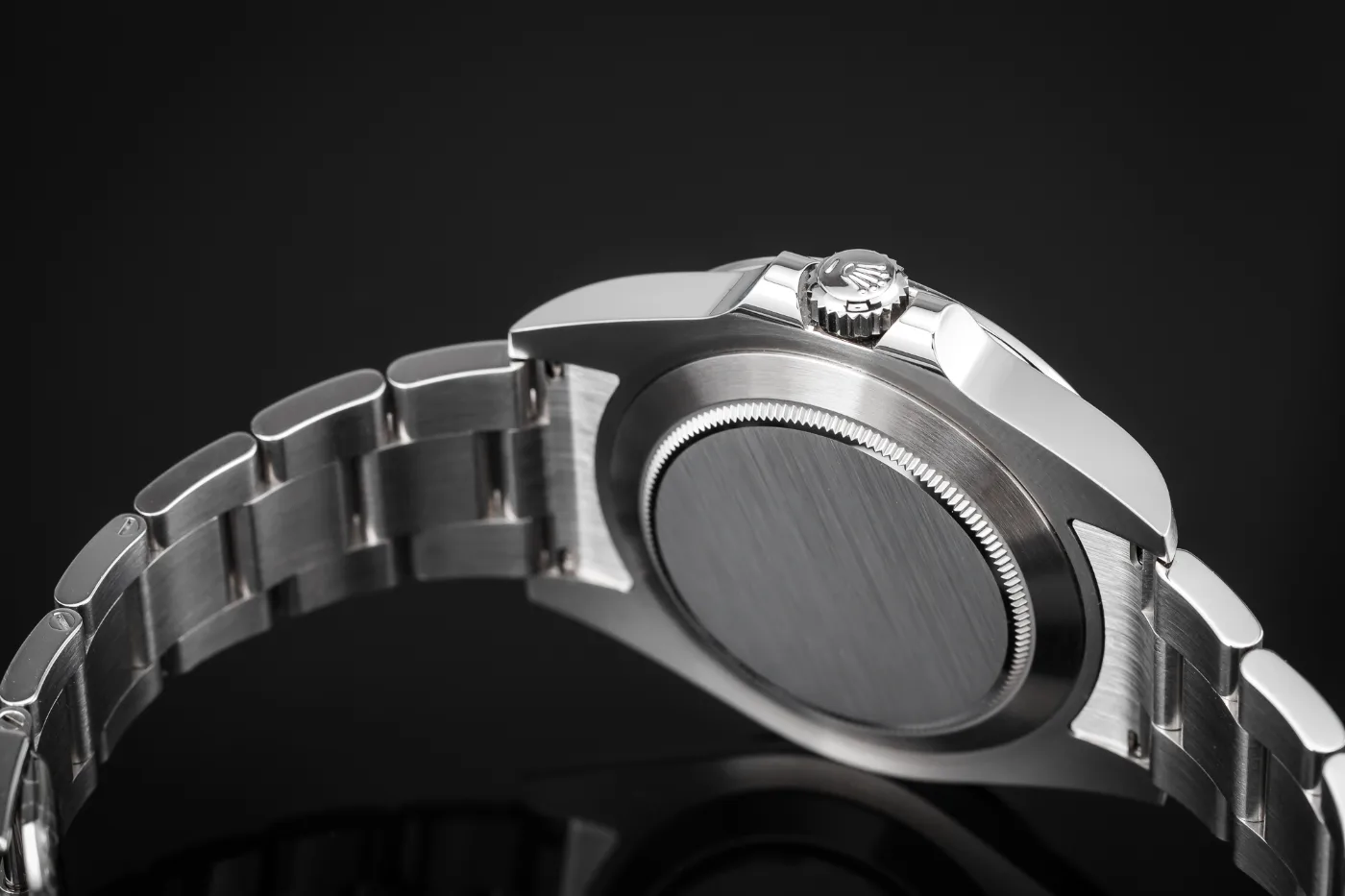
No. The 216570 features a classic solid screw-down Oyster case back.

What crown is found in the 216570?

Screw-down crown with the Twinlock system.

Does the 216570 have Triplock?

No. The official specification for this reference indicates the Twinlock system with double sealing.

What is the water resistance of the Explorer II 216570?

To 100 meters, or 330 feet.

Can you swim in the Explorer II 216570?

The construction was designed to be waterproof to 100 meters. However, in a used watch, it is worth confirming the current watertightness before regular contact with water.

Is the Explorer II a dive watch?

No. The water resistance is high for a daily and travel watch, but the Explorer II is not a professional dive watch like the Submariner or Sea-Dweller.

Is the crystal sapphire?

Yes. Rolex uses scratch-resistant sapphire crystal.

Does the crystal have a Cyclops lens?

Yes. The lens is located above the date window at 3 o'clock.

Does the Explorer II 216570 have Chromalight?

Yes. The white dial utilizes Chromalight with long-lasting blue luminescence.

When did Rolex introduce Chromalight to the Explorer II?

Rolex states that since 2010, Chromalight has increased the legibility of Explorer and Explorer II models. The 216570 generation, presented a year later, utilized this solution.

How does Chromalight glow?

The luminescent elements emit blue light, improving time reading in low light conditions.

Why is Chromalight particularly important in the Explorer II?

The model was created with environments in mind where natural light may be limited or not allow determining the time of day. High legibility after dark is therefore an integral part of its functionality.

What bracelet does the Rolex Explorer II 216570 have?

A three-link Oyster bracelet made of Oystersteel.

Is this a Jubilee?

No. The Explorer II 216570 factory-fitted uses the sporty three-link Oyster bracelet.

What clasp does it have?

Oysterlock safety folding clasp.

Does the 216570 have Easylink?

Yes. The Easylink system allows increasing the bracelet length by approximately 5 mm without using tools.

What is Easylink for?

It allows quickly increasing comfort when the wrist circumference increases slightly, for example, during heat, travel, or prolonged wear.

Does the 216570 have Glidelock?

No. The factory adjustment solution is Easylink.

Is the Explorer II 216570 suitable for daily wear?

Yes. The steel Oyster construction, sapphire crystal, fixed bezel, automatic movement, and 100-meter water resistance create a very practical daily watch.

Does the Explorer II Polar go with a suit?

It can be worn with a modern suit, especially in less rigorous dress codes. However, it should be remembered that this is a large 42-millimeter professional watch, not a classic thin formal watch.

What colors does the white Polar dial go with?

White, steel, and the orange accent create a very versatile combination. The model pairs well with black, navy, gray, white, beige, olive green, brown, and jeans.

Is the white dial more versatile than the black one?

This is a matter of individual preference. However, the white configuration is more characteristic of the Explorer II and creates an exceptionally strong contrast with the orange hand.

Does the Polar look larger than the version with a black dial?

Light dials can optically appear larger than dark ones, so the white 216570 may seem more substantial despite having the same case.

Is the Explorer II 216570 suitable for a smaller wrist?

It depends on its shape. The case is 42 mm and is definitely larger than many classic Rolexes, so trying it on is highly recommended.

Is the model limited?

No. Rolex did not present the 216570 as a numbered limited edition.

Is the Polar version rarer than the black one?

Rolex does not publish detailed data regarding the number of produced examples of each dial variant, so exact proportions should not be stated without confirmation.

Is the Rolex Explorer II 216570 a collector's watch?

It can be very interesting for a collector because it represents a specific, discontinued generation produced from 2011 to 2021, was introduced for the 40th anniversary of the Explorer II, restored the orange hand inspired by the 1971 model, and utilizes the 3187 caliber.

Is the Explorer II Polar a sure investment?

No. No luxury watch should be presented as an instrument guaranteeing future value growth. The attractiveness of the 216570 should be thought of primarily through the prism of history, design, functionality, and its place in the development of the Explorer II.

Does the discontinuation of the 216570 have collector significance?

Yes. It causes the specification of this generation to be closed. The 216570 remains a model characteristic of the decade between the jubilee modernization in 2011 and the launch of the 226570 generation in 2021.

What is the most important difference between the 216570 and 226570?

One of the most important changes is the movement. The 216570 uses the 3187 caliber with approximately 48 hours of power reserve, while the 226570 received the 3285 caliber offering approximately 70 hours. In 2021, Rolex also redesigned selected case and bracelet elements and improved Chromalight legibility.

Do the 216570 and 226570 have the same diameter?

Yes. Both generations nominally measure 42 mm.

Does the 226570 have the same orange hand?

The basic concept of the orange 24-hour hand has been retained in the new generation.

Is the 216570 mechanically the same as the 226570?

No. The 3187 and 3285 belong to two different generations of movements.

Is the newer 226570 automatically a better choice?

No. The newer model offers a more modern movement and longer power reserve, while the 216570 has its own historical identity as the jubilee generation introduced for the 40th anniversary of the Explorer II.

How does the Explorer II differ from the GMT-Master II?

Both watches can show a second time zone, but their construction and history are different. The Explorer II has a fixed metal 24-hour bezel and stems from the world of cave exploration, polar areas, and extreme environments. The GMT-Master II uses a rotating 24-hour bezel and is historically associated primarily with aviation and travel between time zones.

Can the Explorer II replace the GMT-Master II during travel?

Yes, if the user needs two time zones. The independent local hand and the 24-hour reference hand provide a very practical travel function.

Is the Explorer II a more tool-like watch than the GMT-Master II?

Stylistically, it can be perceived as such. The steel fixed bezel, lack of precious metals, and strongly technical white or black dial give the 216570 a very functional character.

Was the Explorer II designed for speleologists?

Yes. Rolex directly cites speleologists as one of the groups particularly associated with the Explorer II. The ability to distinguish day from night is of special significance in deep caves.

Was the model also associated with polar exploration?

Yes. The collection's history includes polar expeditions, and Rolex cites polar areas as an environment where the 24-hour indication helps distinguish the time of day.

Was the Explorer II also used in high-altitude expeditions?

Yes. Rolex describes numerous expeditions and researchers using the Explorer and Explorer II. The collection's history features Ed Viesturs, who completed the project of climbing all 14 eight-thousanders without supplemental oxygen, using the Explorer II.

Does the Explorer II have a connection with Everest?

The history of the entire Explorer family stems from Rolex's experiences related to high-altitude exploration. After Edmund Hillary and Tenzing Norgay reached the summit of Everest in 1953, Rolex presented the Explorer. The Explorer II was created later as a more specialized development of the explorer watch concept.

Can M&M GOLD find a Rolex Explorer II Polar 216570?

Yes. M&M GOLD can search for the precisely specified reference 216570-0001 with a white dial on the professional independent market.

Can a specific year be determined?

Yes. With individual sourcing, a preferred year and requirements for the technical condition of a specific example can be indicated.

Does M&M GOLD verify the 3187 caliber?

Yes. When checking the 216570, it is important to confirm the correct movement, 24-hour function, independent local hour, date function, accuracy, and power reserve.

Is the correct white Polar dial also checked?

Yes. With such a recognizable variant, correct dial identification and configuration compliance with the reference are one of the important elements of verification.

How long does sourcing a Rolex Explorer II 216570 take?

Standard individual sourcing by M&M GOLD takes on average from 7 to 14 business days. If the client expects a very specific year or a precisely specified example, the process may take longer.

How does individual sourcing begin?

The process begins after making a full advance payment, which allows reserving the correct example with a trusted partner.

Does the watch obtained by M&M GOLD come with a warranty?

Watches obtained by M&M GOLD have a minimum one-year warranty on the movement in accordance with the conditions of individual sourcing.

History of the Rolex Explorer II

The history of the Explorer II is part of a much broader Rolex tradition related to the exploration of the world.

Since the 1930s, the brand has provided Oyster watches to participants of expeditions to the most demanding regions of the planet. Watches went to both high mountains and polar regions, and information provided by their users helped Rolex develop the resistance, watertightness, and legibility of its constructions.

A turning point was the year 1953.

On May 29, 1953, Edmund Hillary and Tenzing Norgay became the first to summit Mount Everest during a British expedition led by John Hunt. The expedition participants used Oyster Perpetual chronometers.

As a result of this event, Rolex presented the Explorer model. It was characterized by a legible dial with large 3, 6, and 9 markings and a triangle at 12 o'clock. The construction was subordinated to legibility in demanding conditions.

The Birth of the Explorer II in 1971

The Explorer II was presented in 1971.

It was not simply a larger Explorer.

Rolex created a more specialized tool equipped with an additional orange 24-hour hand and a fixed, scaled bezel.

The function allowed the user to distinguish day from night in a situation where the surrounding environment did not provide such information. This could happen deep underground or in polar regions during periods when the sun hardly sets.

This is precisely why the Explorer II created its own category in the Rolex offer.

It was not a typical aviation watch.

It was not a dive watch.

It was not a classic mountain model either.

It was a tool for people moving in an environment where the natural rhythm of day and night might cease to be obvious.

The Orange Hand of the First Explorer II

One of the most recognizable elements of the original 1971 model was the large orange 24-hour hand.

In later generations, the style of this element changed.

When Rolex prepared the model for the 40th anniversary of the Explorer II in 2011, it decided to reuse the intense orange coloration.

This was not a random stylistic decision.

It was a direct reference to the first generation from 1971.

Explorer II and Haroun Tazieff

Rolex describes in the collection's history the Franco-Belgian volcanologist Haroun Tazieff.

Tazieff conducted research in extreme temperatures and in the environment of aggressive volcanic gases.

The Explorer II accompanied him, among other things, during work on Etna.

In 1972, Tazieff provided Rolex with information regarding the very good performance of the watch in exceptionally difficult conditions.

The connection of the model with such users helps understand its character.

The Explorer II was not created as a luxury variation of a classic watch.

It was first meant to be a tool.

Evolution of the Second Time Zone Function

In the first concept, the 24-hour indication served primarily to distinguish day from night.

In 1982, the Explorer II reached another significant stage of development.

Rolex implemented a mechanism allowing the regulation of the hour hand independently of the minute and 24-hour hands.

Thanks to this, the watch could from that moment simultaneously indicate a second time zone.

This was a fundamental functional change.

The Explorer II retained its original application but also became a very practical travel watch.

Explorer II and Polar Expeditions

The connection of the Explorer II with polar regions is not solely the result of the later nickname „Polar Dial”.

Rolex has for decades provided watches to participants of expeditions taking place in the most extreme regions of the world.

In the polar environment, the problem with natural distinction between day and night is real.

During polar summer, the sun may remain above the horizon for a full day.

During polar winter, darkness may dominate for a long time.

The 24-hour indication of the Explorer II allows maintaining orientation in the daily cycle regardless of the amount of light outside.

Explorer II and Caves

Even more obvious environments for this function are caves.

Deep underground, there is no direct information about sunrise and sunset.

A standard 12-hour dial may show 7 o'clock, but without additional information, the user does not know if it is 7 AM or 7 PM.

The 24-hour hand solves this problem.

This is precisely why Rolex has long strongly associated the Explorer II with speleologists.

Erling Kagge and the Three Poles

One of the most interesting figures in the history of the Explorer II is the Norwegian explorer Erling Kagge.

Kagge was the first person to realize the so-called Three Poles challenge, reaching the North Pole, the South Pole, and the summit of Mount Everest.

Rolex states that he achieved all three feats with an Explorer II on his wrist.

Thanks to such stories, the Explorer II has maintained a very authentic connection with exploration that goes beyond the watch's design itself.

Ed Viesturs and the Highest Mountains in the World

American Himalayan Ed Viesturs also played a significant role in the model's history.

He completed the project of climbing all 14 peaks exceeding 8,000 meters without using supplemental oxygen.

The Explorer II accompanied him during the realization of this extraordinary undertaking.

From the perspective of the model's character, this is of great significance.

The Rolex Explorer II was not merely designed in a laboratory as a watch that looks resistant.

Subsequent generations were used by people actually operating in extreme environments.

Chromalight and the Year 2010

In 2010, the Explorer and Explorer II collections received Chromalight.

The new luminescent material was white in daylight, while in the dark, it emitted a long-lasting blue glow.

The change was particularly logical precisely in the Explorer II.

A watch whose history includes caves, high mountains, night expeditions, and polar regions must ensure very good legibility regardless of the availability of natural light.

The Year 2011 and the Birth of the Rolex Explorer II 216570

The year 2011 is key for the reference described.

The Explorer II was celebrating its 40th anniversary.

Rolex used the jubilee to carry out one of the largest modernizations of the model.

The case diameter was increased to 42 mm.

The large orange 24-hour hand was restored.

The 3187 caliber was implemented.

The movement was equipped with a blue Parachrom hairspring and Paraflex shock absorbers.

In this way, a modern construction was very clearly combined with the appearance of the first Explorer II from 1971.

Why Was 42 mm an Important Change?

The Explorer II has always been a professional tool watch.

Increasing the diameter to 42 mm improved legibility and made the model stand out even more strongly from other steel Rolex Professionals.

The larger dial also gave more space for large indices and the orange 24-hour hand.

The result is particularly visible in the Polar version.

The white dial field occupies a large surface area, so the watch has a very strong visual presence.

The White Polar Dial

The white dial is likely the most recognizable variant of the 216570.

Its design is based on extreme contrast.

The background is light.

The outlines of large indices and hands are dark.

The central 24-hour hand is intensely orange.

The steel bezel has black markings.

Thanks to this, almost every element has its own clearly defined visual function.

Black Contrast on the White Dial

In a classic watch with a white dial, metal hands may blend with the background under certain conditions.

The Explorer II solves this problem by applying very clear dark frames.

This allows maintaining immediate time legibility.

The orange 24-hour hand is so color-wise different that it is practically impossible to confuse it with the main hour hand.

The Orange Hand as a Recognizable Sign

In the 216570, the 24-hour hand is not a subtle detail.

It has a large surface area and a characteristic triangular arrowhead.

With a white dial, the intense orange color becomes one of the first elements noticed on the watch.

It is precisely the combination of white, black, steel, and orange that created the exceptionally recognizable look of the Polar 216570.

The Fixed Steel Bezel

In the world of contemporary professional Rolexes, where many models use ceramic Cerachrom bezels, the Explorer II remains a characteristic exception.

The 216570 uses a steel bezel.

It is fixed and has engraved 24-hour scale markings.

The solution strongly emphasizes the technical character of the watch.

There is no colored ceramic insert or rotating mechanism here.

The bezel is an integral part of the 24-hour time reading system.

Fixed Bezel vs. GMT-Master II

The difference between the Explorer II and the GMT-Master II is very significant.

The GMT-Master II has a rotating 24-hour ring.

It allows using the GMT hand to read an additional zone as well.

The Explorer II has a fixed scale.

On one hand, this limits the number of possible combinations.

On the other hand, it creates a simpler construction corresponding to the original function of the watch, i.e., constant distinction between day and night hours.

The 3187 Caliber

The 3187 caliber was created for this generation of the Explorer II.

It is an automatic movement produced by Rolex.

It provides central indication of hours, minutes, and seconds, 24-hour indication, the ability to present a second time zone, independent quick setting of the local hour hand, instant date, and hacking seconds.

The movement has approximately 48 hours of power reserve.

This is a parameter that should definitely be remembered for this reference.

Do not attribute to it the approximately 70 hours available in the later 3285 caliber.

Parachrom in the 3187

The blue Parachrom hairspring was made of a paramagnetic alloy.

The element is responsible for an extremely important part of the oscillator's work.

Rolex uses this technology to increase the stability of timekeeping in conditions that may affect a classic mechanical watch.

In the Explorer II, resistance to variable conditions is particularly important due to the collection's intended use.

Paraflex in the 3187

Paraflex shock absorbers constitute another important element of the caliber.

Their task is to limit the impact of shocks on the delicate oscillator system.

Rolex directly mentions Paraflex in the description of the 40th anniversary of the Explorer II as one of the modernizations improving the watch's resistance.

Power Reserve of Approximately 48 Hours

Approximately 48 hours means about two days of operation after full winding.

If the watch is worn regularly, the Perpetual rotor automatically replenishes the spring's energy.

In the case of a used example, the actual power reserve is one of the parameters worth verifying technically.

A significantly shorter operating time may indicate a need for movement diagnostics.

Independent Local Hour Hand

This is the function that changed the Explorer II from a watch serving solely to distinguish day and night into a full-fledged travel watch.

Upon arriving in another time zone, the user does not need to reset the entire mechanism.

They can change just the local hour.

The minutes and seconds remain preserved.

The orange hand continues to indicate the reference time.

Date and Cyclops

The date window is located at 3 o'clock.

A Cyclops lens is placed above it.

In the Explorer II, the date has special historical significance.

Rolex emphasizes that in an environment where it was difficult to distinguish day from night, the ability to control the current date was a useful element of time orientation.

42 mm Oyster Case

The construction includes a monobloc middle case, a screw-down case back, and a screw-down crown.

The watch is waterproof to 100 meters.

The 42 mm causes the 216570 to stand out significantly from many classic Rolexes.

It does not try to be a small formal watch.

The size corresponds to its character as a professional tool.

Twinlock Crown

The screw-down crown uses the Twinlock system.

This is Rolex's double watertightness system.

Do not confuse it with the Triplock used, for example, in the Submariner or selected other Professional models.

Oyster Bracelet

The 216570 has a three-link Oyster bracelet.

The design is simple, sporty, and pairs very well with the steel bezel.

Unlike the more decorative Jubilee, the Oyster does not distract attention from the large dial and orange hand.

The entire watch thus maintains a consistent, functional character.

Oysterlock

The Oysterlock safety folding clasp reduces the risk of accidental opening.

The solution corresponds to the professional purpose of the watch and ensures stable attachment on the wrist.

Easylink

Easylink allows increasing the bracelet length by approximately 5 mm.

Adjustment is done without additional tools.

In practice, it is useful during heat, airplane flights, and natural changes in wrist circumference throughout the day.

Explorer II Polar as a Daily Watch

The 216570 is one of the more practical steel Rolex references.

The white dial is color-neutral.

The steel case and Oyster are suitable for daily use.

The second time zone function is useful during travel.

The date increases practicality.

Water resistance to 100 meters allows for a wide range of normal use.

Sapphire crystal and Oystersteel ensure high resistance to typical daily conditions.

The Character of the Polar Dial

The white dial completely changes the way the watch is perceived.

The black Explorer II looks more uniform and classic.

The Polar is more contrasting.

The white background makes the orange hand much more visible.

The dark outlines of indices and hands create a graphic character almost resembling a measuring instrument.

This is precisely why the Polar became one of the most recognizable white Rolex Professionals.

Rolex Explorer II 216570 vs. Previous Generations

The most important visual change in 2011 concerned size.

Rolex increased the diameter to 42 mm.

At the same time, the strong orange hand inspired by the original Explorer II from 1971 returned.

The 216570 thus constitutes an interesting combination of history and contemporary design at the time.

On one hand, it is clearly larger and more modern than earlier models.

On the other hand, it consciously restores one of the most characteristic elements of the first Explorer II.

Rolex Explorer II 216570 vs. 226570

The change in 2021 was more evolutionary visually than revolutionary.

Rolex retained the 42 mm diameter, white or black dial, orange 24-hour hand, and fixed steel bezel.

The biggest difference is inside.

The 216570 uses the 3187 caliber and approximately 48 hours of power reserve.

The 226570 uses the 3285 caliber and approximately 70 hours of power reserve.

The new generation also received modified case and bracelet proportions and an optimized Chromalight system.

Why Do Some Collectors Choose the 216570 Instead of the 226570?

The 216570 has an exceptionally clearly defined place in the model's history.

It was introduced exactly for the 40th anniversary of the Explorer II.

It was the first 42 mm Explorer II.

It restored the historical orange hand.

It received the characteristic 3187 caliber with Parachrom and Paraflex.

It was produced for about a decade before the next modernization.

For some collectors, these elements may be as important as the technical advantages of the newer movement.

Explorer II Polar vs. GMT-Master II

Both watches can simultaneously indicate two time zones.

Their personalities are, however, completely different.

The GMT-Master II is strongly associated with aviation and international travel.

The Explorer II was created for explorers, speleologists, scientists, and people operating where natural distinction between day and night may be difficult.

The GMT-Master II has a rotating bezel.

The Explorer II has a fixed bezel.

The GMT-Master II uses colored Cerachrom in many configurations.

The Explorer II remains steel and visually raw.

Thanks to this, the 216570 is one of the most tool-like Rolexes with a second time zone function.

Explorer II Polar vs. Submariner

The Submariner was designed primarily with diving in mind.

The Explorer II was created with land and underground exploration in mind.

The Submariner has a rotating bezel for controlling dive time.

The Explorer II has a fixed 24-hour scale.

The Submariner focuses on water.

The Explorer II focuses on time orientation during exploration.

These are two professional Rolexes created for completely different applications.

Explorer II Polar vs. Explorer

The Explorer is a simpler watch in terms of indications.

It shows basic time and focuses on maximum legibility and resistance.

The Explorer II adds a date, 24-hour indication, second time zone, and the characteristic fixed bezel.

It is also larger in the 216570 generation.

The Explorer represents a minimalist tool.

The Explorer II is a more specialized instrument.

Who Is the Rolex Explorer II Polar 216570 For?

This is a model particularly interesting for someone seeking a Rolex Professional other than the Submariner or GMT-Master II.

It may suit a traveler, someone often working with two time zones, a lover of white dials, and a collector seeking a discontinued generation with a clearly defined place in the brand's history.

It is also an interesting proposal for someone who values more technical and less jewelry-like Rolexes.

How to Wear the Rolex Explorer II Polar?

The white dial gives very great freedom.

With a black outfit, the watch creates a very strong contrast.

With navy, it looks more classic.

With white and beige, it gains a more summery character.

With green, khaki, and earth tones, it highlights its exploratory DNA.

The orange hand acts as a small sporty accent and pairs well with both casual and more technical styles.

Explorer II Polar in Business Style

Despite its professional history, the 216570 can be a good business watch, especially for someone who travels.

The white dial pairs well with a shirt.

Steel is neutral.

The second time function has real application for people conducting international business.

However, the 42-millimeter case causes the watch to remain more sporty than a classic Datejust or Day-Date.

The Significance of the 216570 for Collectors

Reference 216570 has several features allowing it to be unambiguously placed on the axis of the Explorer II's history.

It debuted in 2011 on the model's 40th anniversary.

It introduced the 42-millimeter case.

It restored the orange hand of the original generation.

It received the 3187 caliber.

It was produced until the generation change in 2021.

The white Polar configuration additionally became one of the most recognizable variants of the entire collection.

This does not mean a guarantee of value growth.

It means, however, that the 216570 is not a random older reference. It represents a precisely defined stage in the evolution of one of the most important professional Rolex watches.

Authenticity of the Rolex Explorer II 216570 Polar

Professional verification should cover the entire watch.

It is necessary to confirm reference 216570, the correct white dial, the construction of indices and hands, the orange 24-hour hand, the fixed bezel scale, the date function, the Cyclops lens, the 42 mm Oyster case, the Twinlock crown, the Oyster bracelet, the Oysterlock, and the 3187 caliber movement.

The appearance of the white dial alone is not enough to confirm authenticity.

Contemporary popular Rolexes are widely copied, so professional control should take into account both external elements and the movement.

Verification of the 3187 Caliber

The movement is particularly important when distinguishing the 216570 from other generations.

The caliber should correctly perform the basic time function, 24-hour indication, independent quick setting of the local hour hand, date function, and hacking seconds.

Accuracy, automatic winding, and actual power reserve should also be checked.

Approximately 48 hours is the reference parameter for this generation.

Technical Assessment of a Used Explorer II 216570

During inspection, it is worth verifying the operation of the crown, independent hour hand, orange 24-hour hand, date change, positioning of the date under the Cyclops, movement accuracy, power reserve, automatic winding, Chromalight, crystal condition, Oysterlock and Easylink operation, and the watch's current watertightness.

In a model with a second time function, it is also very important to check whether the local hour hand moves correctly in full steps and whether its regulation works properly with the date.

Sourcing Rolex Explorer II „Polar Dial” 216570 via M&M GOLD

M&M GOLD can search for a precisely specified Rolex Explorer II 216570-0001 Polar Dial with a white dial in accordance with the client's individual requirements.

When ordering, one can indicate a specific reference, preferred year, required technical condition, and other parameters important for a specific example.

In the case of a discontinued generation, appropriate identification is of special significance. It is necessary to distinguish the 216570 from the newer 226570 and ensure that the correct white Polar variant is being sought.

Individual sourcing begins after making a full advance payment, which allows reserving the appropriate watch with a trusted partner.

Standardly, the entire process takes on average from 7 to 14 business days. With particularly precise requirements regarding a specific year or example, the time may be longer.

Each watch obtained by M&M GOLD comes from a trusted source, undergoes inspection before release, and has a minimum one-year warranty on the movement.

Why Buy a Rolex Explorer II 216570 Polar at M&M GOLD?

The Explorer II requires precise identification of the generation.

The 216570 and 226570 look very similar at first glance, but they use different movements and have different parameters.

M&M GOLD experts can verify the correct 216570 reference, Polar white configuration, dial and other elements' authenticity, the 3187 caliber, second time zone operation, independent local hand, date function, power reserve, Twinlock crown, technical condition of the case, fixed bezel, crystal, and Oyster bracelet.

M&M GOLD's tradition in the luxury goods industry dates back to 1985. We combine experience in luxury watches, gold, diamonds, and jewelry with individual sourcing of sought-after references.

Rolex Explorer II „Polar Dial” 216570 from M&M GOLD Experts

The Rolex Explorer II 216570-0001 „Polar Dial” is one of the most characteristic white references in the modern history of Rolex Professionals.

The model was presented in 2011 on the occasion of the 40th anniversary of the Explorer II. Rolex increased the case diameter to 42 mm, restored the large orange 24-hour hand referencing the original 1971 model, and implemented the specially prepared 3187 caliber with a Parachrom hairspring and Paraflex shock absorbers.

The white dial creates an exceptionally legible composition. Dark frames of hands and indices clearly stand out against the light background, while the orange 24-hour hand immediately draws attention and allows quick reading of the reference time.

The fixed steel bezel with a 24-hour division distinguishes the Explorer II from the GMT-Master II. Its construction stems directly from the model's original function, i.e., enabling the distinction between day and night for people operating in an environment where natural light ceases to be a reliable reference point.

The Rolex 3187 caliber provides automatic winding, approximately 48 hours of power reserve, second time zone indication, independent quick setting of the local hour hand, instant date, and hacking seconds. The movement uses a blue Parachrom hairspring and high-efficiency Paraflex shock absorbers.

The Oyster case has a diameter of 42 mm and is made of Oystersteel. The crown uses the Twinlock system, the crystal is sapphire, there is a Cyclops above the date, and the declared water resistance is up to 100 meters. The three-link Oyster bracelet works with the Oysterlock safety folding clasp and the Easylink system allowing the length to be increased by approximately 5 mm.

In 2021, Rolex replaced the 216570 with a new 226570. The 42 mm diameter and characteristic styling were retained, but the new generation received the 3285 caliber with approximately 70 hours of power reserve.

Thanks to this, the 216570 remains a clearly defined, discontinued generation.

For a collector, special significance lies in its jubilee debut in 2011, the return of the orange hand inspired by the 1971 Explorer II, the 42-millimeter case, and the 3187 caliber.

The Polar variant additionally stands out with one of the most characteristic white dials in the entire Rolex Professional family.

Through M&M GOLD, one can order a precisely specified Rolex Explorer II 216570 Polar, indicating the preferred year, condition, and individual requirements for a specific example.

The client receives not just any white Explorer II, but a properly identified and verified configuration of the 216570-0001 Polar Dial with the Rolex 3187 caliber.
Rolex Explorer II Polar 216570 na pudełku
Rolex Explorer II Polar 216570
Rolex Explorer II Polar 216570 front
Rolex Explorer II Polar 216570
Rolex Explorer II Polar 216570 koronka
Rolex Explorer II Polar 216570
Rolex Explorer II Polar 216570 dokumenty

Rolex Explorer II "Polar Dial" 216570

Elegant Rolex Explorer watch made of steel. Features a white dial, automatic movement, and 42mm case.

€10,480Made to orderUp to 14 days42mm

Watch made to order

Special Order

This watch is made to order upon 100% upfront payment. You can place the order directly on the website.

Bespoke piece, made to individual order (100% prepayment). Under applicable consumer law for custom-made goods, this item is non-returnable.

Lead time

Up to 14 days

Payment

100% prepayment

Enquire
M&M GOLD guarantees the full authenticity and lawful provenance of every watch we sell. Each timepiece undergoes rigorous testing by experts who verify its technical condition, the originality of all components and compliance with the manufacturer’s standards. This gives you complete confidence that the watch you acquire is fully authentic, of legal origin and meets our quality standards.
VIP chauffeur delivery to your home or office. Please contact our expert.
BrandRolex
ModelExplorer II
REFERENCE216570
MaterialSteel
CASE DIAMETER42 mm
MOVEMENTAutomatic
DIAL COLORWhite
CONDITIONVery Good
YEAR OF PRODUCTION2020
Case Size42mm
Reference Number216570
DocumentsOriginal box

Rolex Explorer II "Polar Dial" 216570

Rolex Explorer II „Polar Dial” 216570, white dial, Oystersteel 42 mm

The Rolex Explorer II „Polar Dial” with reference 216570 is one of the most distinctive professional Rolex watches from the previous generation. This model combines a large Oyster case for a classic brand watch with a diameter of 42 mm, a white dial with exceptionally high contrast, an orange 24-hour hand, a fixed steel bezel engraved with a 24-hour scale, and an Oyster three-link bracelet.

The white configuration is identified as Rolex Oyster Perpetual Explorer II 216570-0001. Official Rolex documentation for this reference specifies a white dial, a 42 mm case made of Oystersteel, a fixed 24-hour bezel, the automatic caliber 3187, approximately 48 hours of power reserve, a sapphire crystal with a Cyclops lens, water resistance to 100 meters, and an Oyster bracelet with Oysterlock and Easylink.

The term „Polar” or „Polar Dial” is not an official Rolex name. It is a widely used collector's nickname referring to the white dial of the Explorer II. The name fits the collection's history perfectly, as the Explorer II was designed, among other things, for environments where natural distinction between day and night becomes difficult, such as caves or polar regions, where the sun may not set for a long time during summer. Rolex itself cites caves and polar regions as examples of where the 24-hour indication of the Explorer II is applied.

The full identification of the watch described is:

Rolex Oyster Perpetual Explorer II 216570-0001 „Polar Dial”, 42 mm, white dial, Oystersteel, Oyster bracelet.

Reference 216570 appeared in 2011, exactly on the 40th anniversary of the Explorer II. Rolex significantly modernized the model at that time, increasing the case diameter to 42 mm and restoring the large orange 24-hour hand, characteristic of the original Explorer II from 1971. Inside, it featured the caliber 3187, specially prepared for this model, with a Parachrom hairspring and Paraflex shock absorbers.

In 2021, reference 216570 was replaced by a new generation, 226570. The 42 mm diameter, characteristic white dial, and orange 24-hour hand were retained, but the new Rolex caliber 3285 was used, providing approximately 70 hours of power reserve. Thus, 216570 remains a closed generation of the Explorer II, whose character is defined by the 3187 caliber, approximately 48 hours of power reserve, and the design introduced for the collection's 40th anniversary.

M&M GOLD's tradition in the luxury goods industry dates back to 1985. M&M GOLD experts help find the precisely specified Rolex Explorer II 216570 Polar, verify the correct dial variant, watch authenticity, caliber 3187, second time zone function, and the technical condition of a specific example.

Rolex Explorer II „Polar Dial” 216570, key parameters

The Rolex Explorer II 216570-0001 features an Oyster case with a diameter of 42 mm made of Oystersteel from the 904L steel family, a white dial, a fixed steel bezel with a 24-hour scale, the characteristic orange 24-hour hand ending in a large arrowhead, central hour, minute, and second hands, a date window at 3 o'clock, a Cyclops lens, the automatic in-house Rolex caliber 3187, independent quick setting of the local hour hand, hacking seconds, approximately 48 hours of power reserve, a paramagnetic blue Parachrom hairspring, Paraflex shock absorbers, a screw-down Twinlock crown, sapphire crystal, water resistance to 100 meters, Chromalight display with long-lasting blue luminescence, and a three-link Oyster bracelet with an Oysterlock safety folding clasp and Easylink system allowing the bracelet length to be increased by approximately 5 mm.

Frequently Asked Questions about Rolex Explorer II „Polar Dial” 216570

What is the reference number of the Rolex Explorer II Polar Dial?

The white Explorer II of the previous generation has the base reference 216570, while the official configuration with a white dial is designated as 216570-0001.

Is „Polar Dial” an official Rolex name?

No. Officially, Rolex simply refers to the dial as white. „Polar” or „Polar Dial” is a very common nickname used by collectors and professional dealers.

Why is the white Explorer II called Polar?

The nickname primarily refers to the snow-white dial and the adventurous character of the model. An additional justification is the history of the Explorer II, which was designed with people operating in environments such as caves and polar areas in mind, where natural recognition of day and night can be difficult.

Is every Rolex Explorer II 216570 a Polar?

No. Reference 216570 was available with both white and black dials. The term Polar primarily refers to the white version.

What is the exact variant of the white dial?

Rolex Explorer II 216570-0001. The official Rolex brochure for this variant indicates a white dial.

When did Rolex introduce the Explorer II 216570?

In 2011. The model was presented on the occasion of the 40th anniversary of the Explorer II.

Why was the year 2011 important for the Explorer II?

Rolex then undertook a major modernization of the model. The case was increased to 42 mm, the characteristic orange 24-hour hand known from the original Explorer II from 1971 was restored, and the watch received the 3187 caliber.

Until when was the 216570 produced?

The 216570 generation remained the representative of the Explorer II until 2021, when Rolex presented the new 226570 generation powered by the 3285 caliber.

Is the Rolex Explorer II 216570 still in production?

No. This is a discontinued generation. The current successor is the Explorer II 226570.

Does Rolex still produce the white Explorer II?

Yes. The white dial remains part of the collection even after the generation change, but the contemporary model has reference 226570 and the 3285 caliber.

Is the new 226570 also called Polar?

Yes, the term Polar is used by the market for the white 226570 as well. Therefore, when purchasing, it is best to always use the exact reference number to distinguish between generations.

What is the diameter of the Rolex Explorer II 216570?

42 mm. This was one of the most important changes introduced in 2011.

Was the 216570 the first 42 mm Explorer II?

Yes. Rolex states that during the modernization for the 40th anniversary in 2011, the Explorer II diameter was increased to 42 mm.

Does 42 mm mean that the Explorer II is a large Rolex?

Yes. Compared to many classic Rolex models, 42 mm gives it a distinct presence on the wrist. However, one must also take into account the case shape, bracelet width, and individual wrist structure.

Is the 216570 larger than the Rolex GMT-Master II?

Yes, in terms of nominal case diameter. The Explorer II 216570 has 42 mm, while the contemporary GMT-Master II uses a 40 mm case.

What is the 216570 made of?

Oystersteel. Rolex classifies Oystersteel as steel belonging to the 904L alloy family, prized for its high corrosion resistance.

Does Rolex use 904L steel in the 216570?

The official Rolex brochure describes Oystersteel as steel belonging to the 904L family.

What color is the Polar dial?

White.

Why is the white dial of the Explorer II so distinctive?

The white background was paired with strongly emphasized dark outlines of hands and indices, and an intensely orange 24-hour hand. This ensures that the individual indications are clearly separated from each other.

Does the white dial have good functional properties?

Yes. The design of the Explorer II has always been subordinated to high legibility. Rolex cites legibility, resistance, and reliability as the fundamental characteristics of the Explorer collection.

What color is the 24-hour hand?

Orange. The hand is one of the most characteristic elements of the Explorer II.

Why is the GMT hand orange?

The orange hand directly references the first Explorer II from 1971. Rolex restored this characteristic element in 2011 on the occasion of the collection's 40th anniversary.

Is the 24-hour hand a GMT hand?

Functionally, it can be used to indicate a second time zone. Rolex describes the 24-hour function in the 216570 specification and the ability to display a second time zone thanks to the independent regulation of the local hour hand.

Does the Explorer II show two time zones?

Yes. The local hour hand can be set independently, while the orange 24-hour hand remains set to the reference time.

Does the Explorer II 216570 show three time zones?

No, not in the same way as the GMT-Master II with a rotating bezel. The Explorer II has a fixed 24-hour bezel, so its primary function is to simultaneously indicate local time and one reference time.

Does the Explorer II bezel rotate?

No. It is fixed. This is one of the fundamental differences between the Explorer II and the GMT-Master II.

Why is the bezel fixed?

The original function of the Explorer II was the reliable distinction between day and night using a hand making one rotation in 24 hours and a fixed scale. The construction was particularly useful in caves or polar regions where natural light may not clearly indicate the time of day.

Is the bezel ceramic?

No. In the 216570, this is a fixed metal bezel made of steel, with a clear 24-hour division.

Does the Explorer II have Cerachrom?

No. Reference 216570 does not use a ceramic Cerachrom bezel.

What does the number 24 on the bezel show?

It is part of the full 24-hour scale working in conjunction with the orange hand. One rotation of this hand corresponds to a full day.

How to distinguish day and night using the Explorer II?

If the 24-hour hand shows a value corresponding to hours 0 to 12, the user can determine the first half of the day, while values 12 to 24 allow unambiguous identification of the second half. This avoids the problem typical of a standard 12-hour indication.

Does the day/night distinction function have practical application today?

Yes, although most users primarily use the orange hand to observe a second time zone. The original function can still be useful in environments without a natural light cycle.

Can the local hour hand be adjusted independently?

Yes. The Rolex 216570 allows quick advancement of the local hour hand independently of the minute and 24-hour hands.

Why is the independent hour hand important during travel?

After changing time zones, the local hour can be adjusted without resetting the minutes and reference time. This is a very practical solution for someone who travels frequently.

Can the hour hand be moved forward and backward?

Yes. The construction allows quick independent regulation of the local hour.

Does the Explorer II have a date function?

Yes. The date window is located at 3 o'clock.

Does it have a Cyclops lens?

Yes. The characteristic Cyclops lens is located above the date window.

Does the date change with the local hour?

The independent local hour function works in conjunction with the date, allowing appropriate adjustment of the day indication during travel when crossing midnight.

What movement is in the Rolex Explorer II 216570?

In-house Rolex caliber 3187.

Was the 3187 caliber produced by Rolex?

Yes. Official documentation describes it as a movement entirely developed and produced by Rolex.

Is the 3187 caliber automatic?

Yes. It is a mechanical automatic movement with bidirectional winding via the Perpetual rotor.

Can the Explorer II be manually wound?

Yes. The automatic movement can also be wound manually via the crown.

What is the power reserve of the 216570?

Approximately 48 hours. This is an important difference compared to the newer 226570, which offers approximately 70 hours.

Does the 216570 have 70 hours of power reserve?

No. This is a common error resulting from mixing two generations. The 216570 with the 3187 caliber has approximately 48 hours, while the 226570 with the 3285 caliber has approximately 70 hours.

Does the 3187 caliber have a Parachrom hairspring?

Yes. Rolex implemented a paramagnetic blue Parachrom hairspring.

Does the 3187 caliber have Paraflex?

Yes. The 3187 was equipped with Paraflex shock absorbers to increase the movement's resistance to shocks.

Why was Paraflex important in the Explorer II?

The Explorer II was created as a professional watch intended for demanding conditions. Increased resistance of the oscillator to shocks is therefore directly consistent with the character of the collection. Rolex emphasized the use of Paraflex at the launch of the 2011 generation as an element improving the watch's resistance.

Does the 3187 have Chronergy?

The 3187 caliber should not be attributed with the technology of the newer 3285 caliber. The Chronergy escapement belongs to a later generation of Rolex movements.

Does the movement have hacking seconds?

Yes. The function allows stopping the second hand during precise time setting.

What is the accuracy of the Rolex Explorer II 216570?

In later official specifications for the 216570, the manufacturer stated the precision of the finished watch at -2/+2 seconds per day after casing. For very early examples, it should be remembered that the Superlative Chronometer standard was tightened by Rolex during the production period of this reference.

Is the Explorer II 216570 a chronometer?

Yes. The 3187 caliber had chronometer certification, and later examples of this generation were covered by the Rolex Superlative Chronometer standard.

Is the movement visible through the case back?

No. The 216570 features a classic solid screw-down Oyster case back.

What crown is found in the 216570?

Screw-down crown with the Twinlock system.

Does the 216570 have Triplock?

No. The official specification for this reference indicates the Twinlock system with double sealing.

What is the water resistance of the Explorer II 216570?

To 100 meters, or 330 feet.

Can you swim in the Explorer II 216570?

The construction was designed to be waterproof to 100 meters. However, in a used watch, it is worth confirming the current watertightness before regular contact with water.

Is the Explorer II a dive watch?

No. The water resistance is high for a daily and travel watch, but the Explorer II is not a professional dive watch like the Submariner or Sea-Dweller.

Is the crystal sapphire?

Yes. Rolex uses scratch-resistant sapphire crystal.

Does the crystal have a Cyclops lens?

Yes. The lens is located above the date window at 3 o'clock.

Does the Explorer II 216570 have Chromalight?

Yes. The white dial utilizes Chromalight with long-lasting blue luminescence.

When did Rolex introduce Chromalight to the Explorer II?

Rolex states that since 2010, Chromalight has increased the legibility of Explorer and Explorer II models. The 216570 generation, presented a year later, utilized this solution.

How does Chromalight glow?

The luminescent elements emit blue light, improving time reading in low light conditions.

Why is Chromalight particularly important in the Explorer II?

The model was created with environments in mind where natural light may be limited or not allow determining the time of day. High legibility after dark is therefore an integral part of its functionality.

What bracelet does the Rolex Explorer II 216570 have?

A three-link Oyster bracelet made of Oystersteel.

Is this a Jubilee?

No. The Explorer II 216570 factory-fitted uses the sporty three-link Oyster bracelet.

What clasp does it have?

Oysterlock safety folding clasp.

Does the 216570 have Easylink?

Yes. The Easylink system allows increasing the bracelet length by approximately 5 mm without using tools.

What is Easylink for?

It allows quickly increasing comfort when the wrist circumference increases slightly, for example, during heat, travel, or prolonged wear.

Does the 216570 have Glidelock?

No. The factory adjustment solution is Easylink.

Is the Explorer II 216570 suitable for daily wear?

Yes. The steel Oyster construction, sapphire crystal, fixed bezel, automatic movement, and 100-meter water resistance create a very practical daily watch.

Does the Explorer II Polar go with a suit?

It can be worn with a modern suit, especially in less rigorous dress codes. However, it should be remembered that this is a large 42-millimeter professional watch, not a classic thin formal watch.

What colors does the white Polar dial go with?

White, steel, and the orange accent create a very versatile combination. The model pairs well with black, navy, gray, white, beige, olive green, brown, and jeans.

Is the white dial more versatile than the black one?

This is a matter of individual preference. However, the white configuration is more characteristic of the Explorer II and creates an exceptionally strong contrast with the orange hand.

Does the Polar look larger than the version with a black dial?

Light dials can optically appear larger than dark ones, so the white 216570 may seem more substantial despite having the same case.

Is the Explorer II 216570 suitable for a smaller wrist?

It depends on its shape. The case is 42 mm and is definitely larger than many classic Rolexes, so trying it on is highly recommended.

Is the model limited?

No. Rolex did not present the 216570 as a numbered limited edition.

Is the Polar version rarer than the black one?

Rolex does not publish detailed data regarding the number of produced examples of each dial variant, so exact proportions should not be stated without confirmation.

Is the Rolex Explorer II 216570 a collector's watch?

It can be very interesting for a collector because it represents a specific, discontinued generation produced from 2011 to 2021, was introduced for the 40th anniversary of the Explorer II, restored the orange hand inspired by the 1971 model, and utilizes the 3187 caliber.

Is the Explorer II Polar a sure investment?

No. No luxury watch should be presented as an instrument guaranteeing future value growth. The attractiveness of the 216570 should be thought of primarily through the prism of history, design, functionality, and its place in the development of the Explorer II.

Does the discontinuation of the 216570 have collector significance?

Yes. It causes the specification of this generation to be closed. The 216570 remains a model characteristic of the decade between the jubilee modernization in 2011 and the launch of the 226570 generation in 2021.

What is the most important difference between the 216570 and 226570?

One of the most important changes is the movement. The 216570 uses the 3187 caliber with approximately 48 hours of power reserve, while the 226570 received the 3285 caliber offering approximately 70 hours. In 2021, Rolex also redesigned selected case and bracelet elements and improved Chromalight legibility.

Do the 216570 and 226570 have the same diameter?

Yes. Both generations nominally measure 42 mm.

Does the 226570 have the same orange hand?

The basic concept of the orange 24-hour hand has been retained in the new generation.

Is the 216570 mechanically the same as the 226570?

No. The 3187 and 3285 belong to two different generations of movements.

Is the newer 226570 automatically a better choice?

No. The newer model offers a more modern movement and longer power reserve, while the 216570 has its own historical identity as the jubilee generation introduced for the 40th anniversary of the Explorer II.

How does the Explorer II differ from the GMT-Master II?

Both watches can show a second time zone, but their construction and history are different. The Explorer II has a fixed metal 24-hour bezel and stems from the world of cave exploration, polar areas, and extreme environments. The GMT-Master II uses a rotating 24-hour bezel and is historically associated primarily with aviation and travel between time zones.

Can the Explorer II replace the GMT-Master II during travel?

Yes, if the user needs two time zones. The independent local hand and the 24-hour reference hand provide a very practical travel function.

Is the Explorer II a more tool-like watch than the GMT-Master II?

Stylistically, it can be perceived as such. The steel fixed bezel, lack of precious metals, and strongly technical white or black dial give the 216570 a very functional character.

Was the Explorer II designed for speleologists?

Yes. Rolex directly cites speleologists as one of the groups particularly associated with the Explorer II. The ability to distinguish day from night is of special significance in deep caves.

Was the model also associated with polar exploration?

Yes. The collection's history includes polar expeditions, and Rolex cites polar areas as an environment where the 24-hour indication helps distinguish the time of day.

Was the Explorer II also used in high-altitude expeditions?

Yes. Rolex describes numerous expeditions and researchers using the Explorer and Explorer II. The collection's history features Ed Viesturs, who completed the project of climbing all 14 eight-thousanders without supplemental oxygen, using the Explorer II.

Does the Explorer II have a connection with Everest?

The history of the entire Explorer family stems from Rolex's experiences related to high-altitude exploration. After Edmund Hillary and Tenzing Norgay reached the summit of Everest in 1953, Rolex presented the Explorer. The Explorer II was created later as a more specialized development of the explorer watch concept.

Can M&M GOLD find a Rolex Explorer II Polar 216570?

Yes. M&M GOLD can search for the precisely specified reference 216570-0001 with a white dial on the professional independent market.

Can a specific year be determined?

Yes. With individual sourcing, a preferred year and requirements for the technical condition of a specific example can be indicated.

Does M&M GOLD verify the 3187 caliber?

Yes. When checking the 216570, it is important to confirm the correct movement, 24-hour function, independent local hour, date function, accuracy, and power reserve.

Is the correct white Polar dial also checked?

Yes. With such a recognizable variant, correct dial identification and configuration compliance with the reference are one of the important elements of verification.

How long does sourcing a Rolex Explorer II 216570 take?

Standard individual sourcing by M&M GOLD takes on average from 7 to 14 business days. If the client expects a very specific year or a precisely specified example, the process may take longer.

How does individual sourcing begin?

The process begins after making a full advance payment, which allows reserving the correct example with a trusted partner.

Does the watch obtained by M&M GOLD come with a warranty?

Watches obtained by M&M GOLD have a minimum one-year warranty on the movement in accordance with the conditions of individual sourcing.

History of the Rolex Explorer II

The history of the Explorer II is part of a much broader Rolex tradition related to the exploration of the world.

Since the 1930s, the brand has provided Oyster watches to participants of expeditions to the most demanding regions of the planet. Watches went to both high mountains and polar regions, and information provided by their users helped Rolex develop the resistance, watertightness, and legibility of its constructions.

A turning point was the year 1953.

On May 29, 1953, Edmund Hillary and Tenzing Norgay became the first to summit Mount Everest during a British expedition led by John Hunt. The expedition participants used Oyster Perpetual chronometers.

As a result of this event, Rolex presented the Explorer model. It was characterized by a legible dial with large 3, 6, and 9 markings and a triangle at 12 o'clock. The construction was subordinated to legibility in demanding conditions.

The Birth of the Explorer II in 1971

The Explorer II was presented in 1971.

It was not simply a larger Explorer.

Rolex created a more specialized tool equipped with an additional orange 24-hour hand and a fixed, scaled bezel.

The function allowed the user to distinguish day from night in a situation where the surrounding environment did not provide such information. This could happen deep underground or in polar regions during periods when the sun hardly sets.

This is precisely why the Explorer II created its own category in the Rolex offer.

It was not a typical aviation watch.

It was not a dive watch.

It was not a classic mountain model either.

It was a tool for people moving in an environment where the natural rhythm of day and night might cease to be obvious.

The Orange Hand of the First Explorer II

One of the most recognizable elements of the original 1971 model was the large orange 24-hour hand.

In later generations, the style of this element changed.

When Rolex prepared the model for the 40th anniversary of the Explorer II in 2011, it decided to reuse the intense orange coloration.

This was not a random stylistic decision.

It was a direct reference to the first generation from 1971.

Explorer II and Haroun Tazieff

Rolex describes in the collection's history the Franco-Belgian volcanologist Haroun Tazieff.

Tazieff conducted research in extreme temperatures and in the environment of aggressive volcanic gases.

The Explorer II accompanied him, among other things, during work on Etna.

In 1972, Tazieff provided Rolex with information regarding the very good performance of the watch in exceptionally difficult conditions.

The connection of the model with such users helps understand its character.

The Explorer II was not created as a luxury variation of a classic watch.

It was first meant to be a tool.

Evolution of the Second Time Zone Function

In the first concept, the 24-hour indication served primarily to distinguish day from night.

In 1982, the Explorer II reached another significant stage of development.

Rolex implemented a mechanism allowing the regulation of the hour hand independently of the minute and 24-hour hands.

Thanks to this, the watch could from that moment simultaneously indicate a second time zone.

This was a fundamental functional change.

The Explorer II retained its original application but also became a very practical travel watch.

Explorer II and Polar Expeditions

The connection of the Explorer II with polar regions is not solely the result of the later nickname „Polar Dial”.

Rolex has for decades provided watches to participants of expeditions taking place in the most extreme regions of the world.

In the polar environment, the problem with natural distinction between day and night is real.

During polar summer, the sun may remain above the horizon for a full day.

During polar winter, darkness may dominate for a long time.

The 24-hour indication of the Explorer II allows maintaining orientation in the daily cycle regardless of the amount of light outside.

Explorer II and Caves

Even more obvious environments for this function are caves.

Deep underground, there is no direct information about sunrise and sunset.

A standard 12-hour dial may show 7 o'clock, but without additional information, the user does not know if it is 7 AM or 7 PM.

The 24-hour hand solves this problem.

This is precisely why Rolex has long strongly associated the Explorer II with speleologists.

Erling Kagge and the Three Poles

One of the most interesting figures in the history of the Explorer II is the Norwegian explorer Erling Kagge.

Kagge was the first person to realize the so-called Three Poles challenge, reaching the North Pole, the South Pole, and the summit of Mount Everest.

Rolex states that he achieved all three feats with an Explorer II on his wrist.

Thanks to such stories, the Explorer II has maintained a very authentic connection with exploration that goes beyond the watch's design itself.

Ed Viesturs and the Highest Mountains in the World

American Himalayan Ed Viesturs also played a significant role in the model's history.

He completed the project of climbing all 14 peaks exceeding 8,000 meters without using supplemental oxygen.

The Explorer II accompanied him during the realization of this extraordinary undertaking.

From the perspective of the model's character, this is of great significance.

The Rolex Explorer II was not merely designed in a laboratory as a watch that looks resistant.

Subsequent generations were used by people actually operating in extreme environments.

Chromalight and the Year 2010

In 2010, the Explorer and Explorer II collections received Chromalight.

The new luminescent material was white in daylight, while in the dark, it emitted a long-lasting blue glow.

The change was particularly logical precisely in the Explorer II.

A watch whose history includes caves, high mountains, night expeditions, and polar regions must ensure very good legibility regardless of the availability of natural light.

The Year 2011 and the Birth of the Rolex Explorer II 216570

The year 2011 is key for the reference described.

The Explorer II was celebrating its 40th anniversary.

Rolex used the jubilee to carry out one of the largest modernizations of the model.

The case diameter was increased to 42 mm.

The large orange 24-hour hand was restored.

The 3187 caliber was implemented.

The movement was equipped with a blue Parachrom hairspring and Paraflex shock absorbers.

In this way, a modern construction was very clearly combined with the appearance of the first Explorer II from 1971.

Why Was 42 mm an Important Change?

The Explorer II has always been a professional tool watch.

Increasing the diameter to 42 mm improved legibility and made the model stand out even more strongly from other steel Rolex Professionals.

The larger dial also gave more space for large indices and the orange 24-hour hand.

The result is particularly visible in the Polar version.

The white dial field occupies a large surface area, so the watch has a very strong visual presence.

The White Polar Dial

The white dial is likely the most recognizable variant of the 216570.

Its design is based on extreme contrast.

The background is light.

The outlines of large indices and hands are dark.

The central 24-hour hand is intensely orange.

The steel bezel has black markings.

Thanks to this, almost every element has its own clearly defined visual function.

Black Contrast on the White Dial

In a classic watch with a white dial, metal hands may blend with the background under certain conditions.

The Explorer II solves this problem by applying very clear dark frames.

This allows maintaining immediate time legibility.

The orange 24-hour hand is so color-wise different that it is practically impossible to confuse it with the main hour hand.

The Orange Hand as a Recognizable Sign

In the 216570, the 24-hour hand is not a subtle detail.

It has a large surface area and a characteristic triangular arrowhead.

With a white dial, the intense orange color becomes one of the first elements noticed on the watch.

It is precisely the combination of white, black, steel, and orange that created the exceptionally recognizable look of the Polar 216570.

The Fixed Steel Bezel

In the world of contemporary professional Rolexes, where many models use ceramic Cerachrom bezels, the Explorer II remains a characteristic exception.

The 216570 uses a steel bezel.

It is fixed and has engraved 24-hour scale markings.

The solution strongly emphasizes the technical character of the watch.

There is no colored ceramic insert or rotating mechanism here.

The bezel is an integral part of the 24-hour time reading system.

Fixed Bezel vs. GMT-Master II

The difference between the Explorer II and the GMT-Master II is very significant.

The GMT-Master II has a rotating 24-hour ring.

It allows using the GMT hand to read an additional zone as well.

The Explorer II has a fixed scale.

On one hand, this limits the number of possible combinations.

On the other hand, it creates a simpler construction corresponding to the original function of the watch, i.e., constant distinction between day and night hours.

The 3187 Caliber

The 3187 caliber was created for this generation of the Explorer II.

It is an automatic movement produced by Rolex.

It provides central indication of hours, minutes, and seconds, 24-hour indication, the ability to present a second time zone, independent quick setting of the local hour hand, instant date, and hacking seconds.

The movement has approximately 48 hours of power reserve.

This is a parameter that should definitely be remembered for this reference.

Do not attribute to it the approximately 70 hours available in the later 3285 caliber.

Parachrom in the 3187

The blue Parachrom hairspring was made of a paramagnetic alloy.

The element is responsible for an extremely important part of the oscillator's work.

Rolex uses this technology to increase the stability of timekeeping in conditions that may affect a classic mechanical watch.

In the Explorer II, resistance to variable conditions is particularly important due to the collection's intended use.

Paraflex in the 3187

Paraflex shock absorbers constitute another important element of the caliber.

Their task is to limit the impact of shocks on the delicate oscillator system.

Rolex directly mentions Paraflex in the description of the 40th anniversary of the Explorer II as one of the modernizations improving the watch's resistance.

Power Reserve of Approximately 48 Hours

Approximately 48 hours means about two days of operation after full winding.

If the watch is worn regularly, the Perpetual rotor automatically replenishes the spring's energy.

In the case of a used example, the actual power reserve is one of the parameters worth verifying technically.

A significantly shorter operating time may indicate a need for movement diagnostics.

Independent Local Hour Hand

This is the function that changed the Explorer II from a watch serving solely to distinguish day and night into a full-fledged travel watch.

Upon arriving in another time zone, the user does not need to reset the entire mechanism.

They can change just the local hour.

The minutes and seconds remain preserved.

The orange hand continues to indicate the reference time.

Date and Cyclops

The date window is located at 3 o'clock.

A Cyclops lens is placed above it.

In the Explorer II, the date has special historical significance.

Rolex emphasizes that in an environment where it was difficult to distinguish day from night, the ability to control the current date was a useful element of time orientation.

42 mm Oyster Case

The construction includes a monobloc middle case, a screw-down case back, and a screw-down crown.

The watch is waterproof to 100 meters.

The 42 mm causes the 216570 to stand out significantly from many classic Rolexes.

It does not try to be a small formal watch.

The size corresponds to its character as a professional tool.

Twinlock Crown

The screw-down crown uses the Twinlock system.

This is Rolex's double watertightness system.

Do not confuse it with the Triplock used, for example, in the Submariner or selected other Professional models.

Oyster Bracelet

The 216570 has a three-link Oyster bracelet.

The design is simple, sporty, and pairs very well with the steel bezel.

Unlike the more decorative Jubilee, the Oyster does not distract attention from the large dial and orange hand.

The entire watch thus maintains a consistent, functional character.

Oysterlock

The Oysterlock safety folding clasp reduces the risk of accidental opening.

The solution corresponds to the professional purpose of the watch and ensures stable attachment on the wrist.

Easylink

Easylink allows increasing the bracelet length by approximately 5 mm.

Adjustment is done without additional tools.

In practice, it is useful during heat, airplane flights, and natural changes in wrist circumference throughout the day.

Explorer II Polar as a Daily Watch

The 216570 is one of the more practical steel Rolex references.

The white dial is color-neutral.

The steel case and Oyster are suitable for daily use.

The second time zone function is useful during travel.

The date increases practicality.

Water resistance to 100 meters allows for a wide range of normal use.

Sapphire crystal and Oystersteel ensure high resistance to typical daily conditions.

The Character of the Polar Dial

The white dial completely changes the way the watch is perceived.

The black Explorer II looks more uniform and classic.

The Polar is more contrasting.

The white background makes the orange hand much more visible.

The dark outlines of indices and hands create a graphic character almost resembling a measuring instrument.

This is precisely why the Polar became one of the most recognizable white Rolex Professionals.

Rolex Explorer II 216570 vs. Previous Generations

The most important visual change in 2011 concerned size.

Rolex increased the diameter to 42 mm.

At the same time, the strong orange hand inspired by the original Explorer II from 1971 returned.

The 216570 thus constitutes an interesting combination of history and contemporary design at the time.

On one hand, it is clearly larger and more modern than earlier models.

On the other hand, it consciously restores one of the most characteristic elements of the first Explorer II.

Rolex Explorer II 216570 vs. 226570

The change in 2021 was more evolutionary visually than revolutionary.

Rolex retained the 42 mm diameter, white or black dial, orange 24-hour hand, and fixed steel bezel.

The biggest difference is inside.

The 216570 uses the 3187 caliber and approximately 48 hours of power reserve.

The 226570 uses the 3285 caliber and approximately 70 hours of power reserve.

The new generation also received modified case and bracelet proportions and an optimized Chromalight system.

Why Do Some Collectors Choose the 216570 Instead of the 226570?

The 216570 has an exceptionally clearly defined place in the model's history.

It was introduced exactly for the 40th anniversary of the Explorer II.

It was the first 42 mm Explorer II.

It restored the historical orange hand.

It received the characteristic 3187 caliber with Parachrom and Paraflex.

It was produced for about a decade before the next modernization.

For some collectors, these elements may be as important as the technical advantages of the newer movement.

Explorer II Polar vs. GMT-Master II

Both watches can simultaneously indicate two time zones.

Their personalities are, however, completely different.

The GMT-Master II is strongly associated with aviation and international travel.

The Explorer II was created for explorers, speleologists, scientists, and people operating where natural distinction between day and night may be difficult.

The GMT-Master II has a rotating bezel.

The Explorer II has a fixed bezel.

The GMT-Master II uses colored Cerachrom in many configurations.

The Explorer II remains steel and visually raw.

Thanks to this, the 216570 is one of the most tool-like Rolexes with a second time zone function.

Explorer II Polar vs. Submariner

The Submariner was designed primarily with diving in mind.

The Explorer II was created with land and underground exploration in mind.

The Submariner has a rotating bezel for controlling dive time.

The Explorer II has a fixed 24-hour scale.

The Submariner focuses on water.

The Explorer II focuses on time orientation during exploration.

These are two professional Rolexes created for completely different applications.

Explorer II Polar vs. Explorer

The Explorer is a simpler watch in terms of indications.

It shows basic time and focuses on maximum legibility and resistance.

The Explorer II adds a date, 24-hour indication, second time zone, and the characteristic fixed bezel.

It is also larger in the 216570 generation.

The Explorer represents a minimalist tool.

The Explorer II is a more specialized instrument.

Who Is the Rolex Explorer II Polar 216570 For?

This is a model particularly interesting for someone seeking a Rolex Professional other than the Submariner or GMT-Master II.

It may suit a traveler, someone often working with two time zones, a lover of white dials, and a collector seeking a discontinued generation with a clearly defined place in the brand's history.

It is also an interesting proposal for someone who values more technical and less jewelry-like Rolexes.

How to Wear the Rolex Explorer II Polar?

The white dial gives very great freedom.

With a black outfit, the watch creates a very strong contrast.

With navy, it looks more classic.

With white and beige, it gains a more summery character.

With green, khaki, and earth tones, it highlights its exploratory DNA.

The orange hand acts as a small sporty accent and pairs well with both casual and more technical styles.

Explorer II Polar in Business Style

Despite its professional history, the 216570 can be a good business watch, especially for someone who travels.

The white dial pairs well with a shirt.

Steel is neutral.

The second time function has real application for people conducting international business.

However, the 42-millimeter case causes the watch to remain more sporty than a classic Datejust or Day-Date.

The Significance of the 216570 for Collectors

Reference 216570 has several features allowing it to be unambiguously placed on the axis of the Explorer II's history.

It debuted in 2011 on the model's 40th anniversary.

It introduced the 42-millimeter case.

It restored the orange hand of the original generation.

It received the 3187 caliber.

It was produced until the generation change in 2021.

The white Polar configuration additionally became one of the most recognizable variants of the entire collection.

This does not mean a guarantee of value growth.

It means, however, that the 216570 is not a random older reference. It represents a precisely defined stage in the evolution of one of the most important professional Rolex watches.

Authenticity of the Rolex Explorer II 216570 Polar

Professional verification should cover the entire watch.

It is necessary to confirm reference 216570, the correct white dial, the construction of indices and hands, the orange 24-hour hand, the fixed bezel scale, the date function, the Cyclops lens, the 42 mm Oyster case, the Twinlock crown, the Oyster bracelet, the Oysterlock, and the 3187 caliber movement.

The appearance of the white dial alone is not enough to confirm authenticity.

Contemporary popular Rolexes are widely copied, so professional control should take into account both external elements and the movement.

Verification of the 3187 Caliber

The movement is particularly important when distinguishing the 216570 from other generations.

The caliber should correctly perform the basic time function, 24-hour indication, independent quick setting of the local hour hand, date function, and hacking seconds.

Accuracy, automatic winding, and actual power reserve should also be checked.

Approximately 48 hours is the reference parameter for this generation.

Technical Assessment of a Used Explorer II 216570

During inspection, it is worth verifying the operation of the crown, independent hour hand, orange 24-hour hand, date change, positioning of the date under the Cyclops, movement accuracy, power reserve, automatic winding, Chromalight, crystal condition, Oysterlock and Easylink operation, and the watch's current watertightness.

In a model with a second time function, it is also very important to check whether the local hour hand moves correctly in full steps and whether its regulation works properly with the date.

Sourcing Rolex Explorer II „Polar Dial” 216570 via M&M GOLD

M&M GOLD can search for a precisely specified Rolex Explorer II 216570-0001 Polar Dial with a white dial in accordance with the client's individual requirements.

When ordering, one can indicate a specific reference, preferred year, required technical condition, and other parameters important for a specific example.

In the case of a discontinued generation, appropriate identification is of special significance. It is necessary to distinguish the 216570 from the newer 226570 and ensure that the correct white Polar variant is being sought.

Individual sourcing begins after making a full advance payment, which allows reserving the appropriate watch with a trusted partner.

Standardly, the entire process takes on average from 7 to 14 business days. With particularly precise requirements regarding a specific year or example, the time may be longer.

Each watch obtained by M&M GOLD comes from a trusted source, undergoes inspection before release, and has a minimum one-year warranty on the movement.

Why Buy a Rolex Explorer II 216570 Polar at M&M GOLD?

The Explorer II requires precise identification of the generation.

The 216570 and 226570 look very similar at first glance, but they use different movements and have different parameters.

M&M GOLD experts can verify the correct 216570 reference, Polar white configuration, dial and other elements' authenticity, the 3187 caliber, second time zone operation, independent local hand, date function, power reserve, Twinlock crown, technical condition of the case, fixed bezel, crystal, and Oyster bracelet.

M&M GOLD's tradition in the luxury goods industry dates back to 1985. We combine experience in luxury watches, gold, diamonds, and jewelry with individual sourcing of sought-after references.

Rolex Explorer II „Polar Dial” 216570 from M&M GOLD Experts

The Rolex Explorer II 216570-0001 „Polar Dial” is one of the most characteristic white references in the modern history of Rolex Professionals.

The model was presented in 2011 on the occasion of the 40th anniversary of the Explorer II. Rolex increased the case diameter to 42 mm, restored the large orange 24-hour hand referencing the original 1971 model, and implemented the specially prepared 3187 caliber with a Parachrom hairspring and Paraflex shock absorbers.

The white dial creates an exceptionally legible composition. Dark frames of hands and indices clearly stand out against the light background, while the orange 24-hour hand immediately draws attention and allows quick reading of the reference time.

The fixed steel bezel with a 24-hour division distinguishes the Explorer II from the GMT-Master II. Its construction stems directly from the model's original function, i.e., enabling the distinction between day and night for people operating in an environment where natural light ceases to be a reliable reference point.

The Rolex 3187 caliber provides automatic winding, approximately 48 hours of power reserve, second time zone indication, independent quick setting of the local hour hand, instant date, and hacking seconds. The movement uses a blue Parachrom hairspring and high-efficiency Paraflex shock absorbers.

The Oyster case has a diameter of 42 mm and is made of Oystersteel. The crown uses the Twinlock system, the crystal is sapphire, there is a Cyclops above the date, and the declared water resistance is up to 100 meters. The three-link Oyster bracelet works with the Oysterlock safety folding clasp and the Easylink system allowing the length to be increased by approximately 5 mm.

In 2021, Rolex replaced the 216570 with a new 226570. The 42 mm diameter and characteristic styling were retained, but the new generation received the 3285 caliber with approximately 70 hours of power reserve.

Thanks to this, the 216570 remains a clearly defined, discontinued generation.

For a collector, special significance lies in its jubilee debut in 2011, the return of the orange hand inspired by the 1971 Explorer II, the 42-millimeter case, and the 3187 caliber.

The Polar variant additionally stands out with one of the most characteristic white dials in the entire Rolex Professional family.

Through M&M GOLD, one can order a precisely specified Rolex Explorer II 216570 Polar, indicating the preferred year, condition, and individual requirements for a specific example.

The client receives not just any white Explorer II, but a properly identified and verified configuration of the 216570-0001 Polar Dial with the Rolex 3187 caliber.
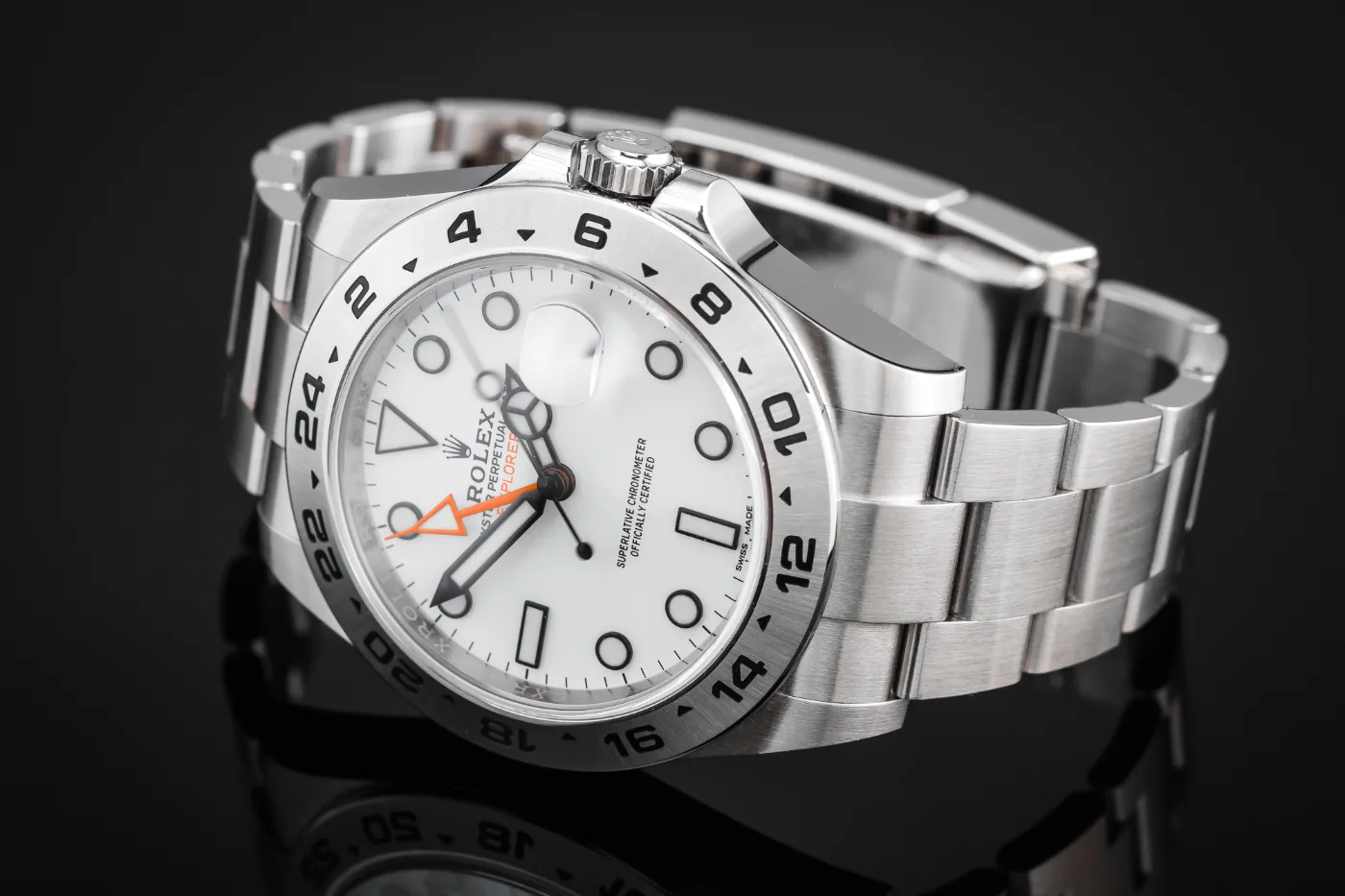
Rolex
Brand
Explorer II
Model
42mm
Case size

THE MOMENT IN WHICH TIME BECOMES A RITUAL

A case or presentation box — according to the brand's guidelines — not only protects the watch, but opens the first act of its story on your wrist. Every detail of the interior and the sales set is meant to highlight the precision of the movement, the finish of the case, and the weight of authentic time. It is not just packaging. It is the M&M GOLD experience.

Discover the magic

Newsletter

Subscribe to our newsletter. Launches, previews and private events.

I agree to receive the newsletter. I can unsubscribe at any time.
€10,480 (Incl. VAT)